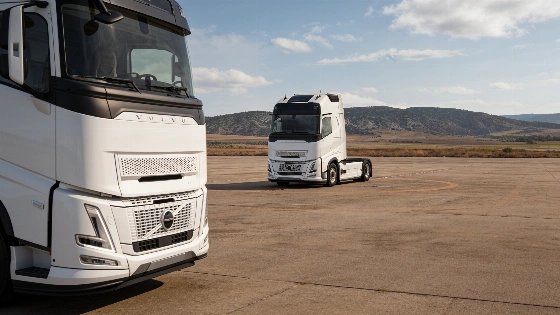
Volvo Trucks has expanded its certified used vehicle program with the Volvo FH Aero, a model that pairs a 13-litre, 460-horsepower engine with features for professional transport operators. The move signals Volvo’s continued investment in combustion technology as the industry develops lower-emission options, including electric and gas-powered models. Introduced in 2024 as part of Volvo’s broader aerodynamic-efficiency strategy, the FH Aero targets long-haul fleets seeking to reduce fuel use while retaining the operational flexibility of a combustion-powered truck.
The FH Aero units now available through Volvo Selected come in a 4x2 configuration, a two-axle tractor layout. They are equipped with the Globetrotter cab, a high-definition Camera Monitor System (CMS) that replaces traditional mirrors, I-Save fuel improvement, I-Park Cool climate control, an aerodynamic deflector package and Michelin tires. Each truck has been maintained under the Volvo Gold contract, the brand’s most comprehensive maintenance and repair program. This combination of aerodynamic equipment and driver-focused features is designed for long-distance operations, where fuel consumption, visibility and vehicle uptime are basic fleet considerations.
Efficiency and Flexibility
Volvo Trucks says its latest 13-litre engine is the most fuel-efficient in the company’s history. Paired with aerodynamic enhancements, it is claimed to deliver up to 4% better fuel economy than the preceding generation. The earlier Volvo Aero range, introduced in 2024, was presented as offering up to 5% lower fuel consumption than its predecessors. These are manufacturer-stated maximum gains, not guaranteed savings on every route. Actual consumption varies with payload and speed, as well as terrain, weather, trailer configuration, tires and driving style.
The engine is described as compatible with biodiesel B100, renewable HVO diesel, biogas and bio-LNG, while green hydrogen is identified as a potential future option. Fuel compatibility does not mean every fuel delivers the same performance or emissions. Outcomes depend on fuel quality and standards, engine configuration, certification and local availability. The European Union’s Alternative Fuels Infrastructure Regulation also requires the development of truck charging infrastructure along major TEN-T corridors and supports wider deployment of alternative-fuel facilities. This allows combustion and electric trucks to coexist as operators adapt routes and depots to new infrastructure.
Comprehensive Support
Every used Volvo FH Aero sold through Volvo Selected includes a service package designed to support fleet management and reduce downtime risks. The Selected Pro Warranty provides 12 months of international coverage for critical components, including the transmission, air conditioning, suspension, steering and electrical systems. Each vehicle also comes with a Blue Maintenance Contract, helping businesses plan and control maintenance costs while maximizing uptime. Warranty coverage and service terms are set out in the vehicle’s purchase documentation.
Operators also gain access to Volvo Connect, the brand’s digital portal for vehicle tracking and fleet services. Fuel Advice and Positioning & Route tools support transport planning and vehicle management, helping operators pursue operational savings alongside their fuel-efficiency goals.
Financing and Market Impact
To ease the integration of these trucks into customer fleets, Volvo offers tailored financing packages through Volvo Financial Services. Since its 2024 launch, the FH Aero has been positioned for long-haul transport, combining aerodynamic design with safety and driver comfort. Its elongated front end is designed to reduce air resistance, alongside the deflector package and other efficiency measures.
The CMS replaces conventional exterior mirrors with camera-based displays. This design can improve forward-side visibility and reduce external aerodynamic drag. Paired with I-Save, the system forms part of the FH Aero’s efficiency package. Volvo’s fuel-economy claims describe potential product performance; legally certified heavy-duty CO₂ values are determined through type-approval procedures using the EU’s VECTO tool. Those values are not interchangeable with real-world fuel-saving percentages.
Growing interest in advanced used trucks reflects a broader shift in the transport sector. Recent coverage of electric vehicle breakthroughs, such as the Skoda Elroq RS outperforming classic supercars in acceleration tests, points to a changing market as operators weigh efficiency, technology and operating requirements.
Context and Outlook
Volvo’s FH Aero strategy highlights the continuing role of combustion engines in European logistics as alternative powertrains gain ground. The European Union’s heavy-duty vehicle CO₂ rules require manufacturers to reduce regulated fleet-average emissions by 45% by 2030, 65% by 2035 and 90% by 2040, compared with 2019 levels. These targets apply to manufacturers’ fleets, rather than requiring every individual truck to be zero-emission. They progressively tighten the performance expected across the market.
The ability to use several specified fuels gives operators another route to adapt, while the transition also depends on fuel availability, infrastructure and vehicle operating needs. For fleets weighing vehicle cost, uptime and emissions performance, the FH Aero’s certified-used offer combines a 460-horsepower, 13-litre powertrain with aerodynamic equipment, warranty coverage and maintenance support. Its market position reflects a wider effort to improve long-haul efficiency as European transport moves toward lower-emission operations.