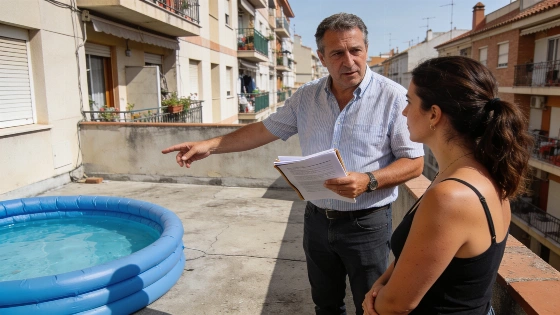
Inflatable pools on terraces are not banned by default in Spain, but their removal can be demanded if they threaten building safety or violate community rules. Understanding the legal and technical limits is crucial before setting one up at home.
Setting up an inflatable pool on your terrace may seem harmless, but Spanish law gives your neighbors the right to demand its removal in certain situations. There is no blanket ban on inflatable pools, yet the risks tied to water weight, building structure, and community statutes can quickly turn a summer convenience into a legal headache.
The updated Ley de Propiedad Horizontal, as published in the BOE on March 21, 2026, does not specifically prohibit inflatable pools. However, if a pool installation is deemed dangerous, causes damage, or breaches the building’s statutes, the community can intervene. Article 7.2 allows the president to require the owner to stop the activity, and if ignored, the community can seek a court order for immediate cessation. There is no automatic rule forcing removal from all terraces—each case depends on the specific risks and circumstances.
Community Procedure
Before any action, the community must follow a set process. The president issues a formal request to the owner or occupant to stop the problematic use. If the situation persists, the community needs approval from the owners’ meeting to file a legal action. A judge can then order the pool to be emptied or removed, and may also require compensation for proven damages. Documentation is key: the community should keep records of all communications and evidence of the issue.
Importantly, removal is not an automatic penalty. The law requires proof of risk or damage. Article 7.1 also forbids changes that affect the building’s safety, structure, exterior, or other owners’ rights. While a portable pool does not always need prior approval if it doesn’t alter shared elements, professional associations recommend informing the community and providing a technical report. This approach is similar to the rules for fixed installations in shared patios, where the impact on communal property is decisive.
Structural Limits
The Código Técnico de la Edificación (CTE) sets a standard load for residential areas at 2 kN/m², roughly 200 kg per square meter. For cantilevered balconies, there’s an extra check: a line load of 2 kN/m along the edge. These figures cover people, furniture, and typical use—not just water. For example, 30 cm of water in a pool adds about 300 kg/m², and a small pool with two adults can easily exceed the safe load. This calculation doesn’t include the pool’s own weight or nearby furniture, and assumes the water stays inside when people enter. The CTE’s reference is a starting point, not a guarantee for every building. Only a technical assessment can confirm if your terrace can safely support a pool.
Building Age and Condition
The real capacity of a terrace depends on its age, materials, and maintenance. Wooden structures behave differently from concrete or steel, and previous repairs, cracks, or dampness can weaken the structure. The Colegio de Aparejadores de Madrid advises that a technical architect should evaluate these factors and the exact pool location. If any structural issues are found, the community may need to consider mandatory repairs. A technical report can also recommend a safe water depth and number of users.
Areas near structural supports are generally stronger than edges, but only a professional can assess the actual safety. A joint statement from professional associations urges owners to consult an expert before buying a pool and to share the technical findings with the community. If the installation requires anchors, reinforcements, or permanent work, additional community and municipal permits may be necessary.
Liability for Damage
Article 9.1 of the Ley de Propiedad Horizontal obliges owners to maintain their property without harming the community or other residents. Owners are also responsible for compensating any damage caused by negligence, including leaks, dampness, or cracks linked to the pool. Article 1902 of the Código Civil reinforces this duty to repair harm caused by careless actions or omissions. Any claim must prove the damage, its cost, and its connection to the pool.
Before filling a pool, owners should check the building’s statutes, the property deed, and any community agreements. A technical evaluation and written notice to the president or administrator are recommended. Insurance coverage will depend on the specific policy and its exclusions—there is no universal rule that insurers will always reject such claims.
If new cracks, deformations, or unusual noises appear, the pool should be emptied immediately and the area closed off until a professional can inspect the structure. As with other household risks, such as unsecured luggage in cars—which can also lead to fines, as highlighted in recent reports on travel safety—the responsibility ultimately falls on the individual to prevent harm to others.