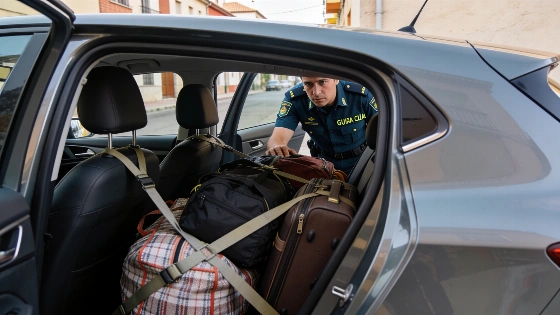
Drivers heading out on holiday in Spain face fines of up to €200 if bags or suitcases are left unsecured inside their vehicles. The Guardia Civil stresses that loose objects can endanger safety and lead to penalties, especially during the busy summer travel season.
Holiday travel in Spain often means packed cars and extra luggage, but a simple oversight could prove costly. The Guardia Civil has issued a clear warning: any bag, suitcase, or object left unsecured inside a vehicle can result in a fine of up to €200. The risk is especially high on the Canary Islands’ roads, where summer journeys are frequent and vehicles are often loaded beyond their usual capacity.
According to the Guardia Civil, the issue is not the presence of bags or personal items in the car, but how they are transported. If a handbag, backpack, or suitcase is left loose—able to slide, roll, or become airborne during sudden braking or a collision—drivers may be penalized. The law requires that all cargo, whether in the trunk or inside the cabin, must be properly secured so it does not affect visibility, stability, or the safety of the vehicle and its occupants.
What the Law Demands
Article 14 of the Reglamento General de Circulación sets out strict rules for how items must be distributed and secured in vehicles. Loads must not drag, fall, shift dangerously, or compromise the car’s balance. They also cannot block lights, license plates, or the driver’s view. Even a small bag on a passenger seat can be a problem if it is not immobilized and could move during a sharp turn or emergency stop.
Officers assess each situation individually, considering whether an object is likely to move or interfere with driving. There is no blanket ban on carrying bags inside the car, but drivers are responsible for ensuring nothing can become a projectile or obstruct their control of the vehicle.
Why Loose Objects Are a Real Danger
Unsecured items pose a serious risk in the event of sudden braking or a crash. The Dirección General de Tráfico (DGT) warns that at just 50 km/h, a loose object can strike passengers with a force up to 40 times its weight—a phenomenon known as the “elephant effect.” This risk extends to improperly installed child seats as well.
Heavier suitcases should always be placed at the bottom of the trunk, as close as possible to the rear seatbacks, to minimize movement and help keep the car stable. Overloading a vehicle not only increases stopping distances but also makes it harder to control in corners and raises the chance of cargo shifting unexpectedly.
How to Pack Safely—and Avoid Fines
The safest option is to keep all luggage in the trunk, distributed evenly with heavier items at the bottom and no empty spaces that could allow movement. The DGT recommends using a closed, aerodynamic roof box if extra space is needed, and only placing items in the cabin as a last resort—never blocking the driver’s view.
Any object on a seat should be strapped down to prevent it from flying forward in a sudden stop. Avoid placing bags on the rear parcel shelf if they reduce rear visibility. If the rear window is blocked, the car must have a right-side exterior mirror. Roof loads must be properly anchored and not exceed legal weight or length limits.
Before setting off, check that all doors and the trunk are securely closed, nothing can slide into the pedal area, and seat belts are accessible. These simple checks can prevent both accidents and fines.
Handling Objects While Driving: Another Risk
Adjusting or picking up items while driving is also a punishable distraction. Moving a bag or suitcase while the car is in motion can lead to an €80 fine. The Guardia Civil advises stopping in a safe place before handling any object that has shifted during the journey.
Ultimately, failing to secure your load can result in a €200 penalty. Officers will consider how items are placed, whether they could move, and if they threaten the safety of passengers or other road users.
As summer travel increases, these rules take on added importance. Even everyday items like a water bottle or a small backpack can become dangerous if left loose. For those planning road trips, a few minutes spent securing luggage can make all the difference.
For travelers interested in compact solutions for holiday journeys, the rise of microcampers like the ARI 458 Pro Camper—recently covered in a feature on new travel vehicles—shows how vehicle design is adapting to modern needs, but the basic rules of safety and load security remain unchanged.