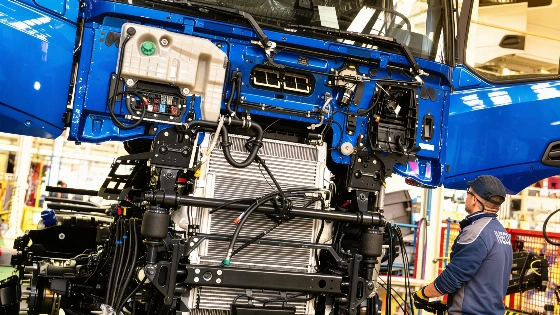
Iveco Madrid Plant: How One Line Produces 40,000 Unique Trucks a Year. The Iveco plant in Madrid manufactures heavy trucks with a record level of customization: up to 40,000 unique configurations are assembled on a single line each year. This degree of personalization and production automation is changing industry standards and impacting the commercial vehicle market in Spain and across Europe.
Iveco's main production center in Madrid has become one of the most technologically advanced and flexible in Europe: here, tens of thousands of heavy trucks are assembled on a single line, almost each one custom-built for the client. This approach is redefining mass automotive manufacturing and setting new industry standards.
Key point
The Iveco plant in Madrid is capable of producing up to 40,000 different heavy truck variants per year, using 267 base models and more than 2,800 options. A one-kilometer production line and automation enable the assembly of vehicles with individual specifications for clients from Spain, Europe, and other countries.
Why it matters
Large-scale customization on a mass production level is rare even for European automotive manufacturing. This allows Iveco to quickly respond to market demands, tighter environmental regulations, and requests from major corporate clients. For Spain, this is an example of high-tech exports and competitiveness on the global market.
Context
In recent years, the commercial vehicle market in Europe has been changing: demand for customized solutions is rising, competition is intensifying, and environmental requirements are becoming increasingly strict. Spain is one of the key markets for heavy trucks, and the Iveco plant in Madrid not only meets domestic demand but also exports vehicles to Italy, Germany, Turkey, and other countries. The implementation of remote emissions monitoring and new inspection standards requires manufacturers to be flexible and technologically advanced.
Who is affected
- Iveco customers: can now order trucks tailored precisely to their needs—from color to technical options.
- The Spanish automotive industry: receives an example of successful integration of automation, sustainable production, and gender balance (25.5% of employees are women).
- Suppliers and related sectors: are involved in synchronized supply chains and logistics.
What may change
- The growth of customization may become the new standard for European truck manufacturers.
- Environmental initiatives (solar panels, water recovery, renewable energy) could raise sustainability requirements for other plants as well.
- Automation and flexible logistics will allow for faster adoption of new technologies and better response to regulatory changes.
What is still unknown
- How quickly other manufacturers will be able to implement a similar level of customization and automation.
- How will demand for custom trucks change amid economic uncertainty or new regulatory requirements?
- What will be the long-term effects of betting on sustainable production for cost price and competitiveness?
How not to misinterpret
- Mass customization does not mean that every truck is completely unique — it's about flexible assembly based on standardized platforms.
- Automation does not eliminate the human role: key stages of quality control and assembly are performed by employees, not just robots.
- Environmental initiatives are part of the overall strategy, but not the only factor in a plant's competitiveness.
Conclusion
The Iveco plant in Madrid has become an example of how mass production can be combined with deep personalization and sustainable technologies. This strengthens the brand’s position in the European market and sets a benchmark for the entire industry. It is important to monitor how such approaches will be adopted by other manufacturers and how they will affect the structure of the commercial vehicle market.