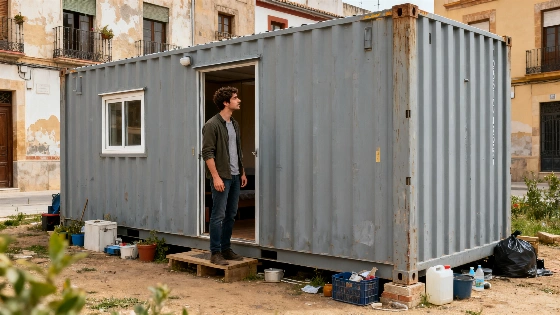
Young Spaniard Turns Shipping Container Into a Home to Avoid Paying Rent. Eloy from Spain chose to forgo a traditional apartment and created his own home in a shipping container. His experience highlights how bureaucracy gets in the way of new forms of housing, while high market prices push people towards unconventional solutions.
Eloy, a young Spaniard, decided not to tie his life to permanent rent or a mortgage. In 2021, he bought a former shipping container and turned it into a fully functional home — a step that, for him, was an answer to the rapid rise in real estate and rental prices.
On his social media, he openly shares the details of remodeling the container, posts photos, and explains why he chose this path. According to him, the container allowed him to have his own space without debt or dependence on landlords. However, in practice, he faced an unexpected problem: by law, his house is not considered official housing, which means he is formally 'living on the street' — despite having a roof over his head.
Eloy notes that bureaucratic barriers are the main obstacle for those who want to live differently. Paperwork, approvals, and official requirements often make such projects almost impossible. At the same time, he believes container homes could be a real solution for people who cannot afford traditional housing.
The advantages of container homes
Among the benefits of this type of housing are affordability, quick assembly, eco-friendliness, and flexible layouts. Containers can be easily adapted to different needs, and converting them takes less time and resources than building a conventional home. Moreover, reusing containers reduces construction waste and helps save materials.
Eloy compares the process of setting up these homes to building with construction sets: the modules can be combined, expanded, or rearranged as needed. This approach is particularly relevant for young people and families who seek independence and do not want to spend most of their income on rent.
Bureaucracy versus new solutions
Despite the obvious advantages, the authorities are in no hurry to officially recognize container homes as proper housing. According to Eloy, it is precisely administrative barriers that hinder the development of such initiatives. He is convinced: if the laws were more flexible, more people could afford their own housing without debts or loans.
A similar problem arises for tourist apartment owners: as noted by RUSSPAIN, new tax regulations and the digital registry create additional difficulties for those seeking alternative living options or looking to earn from real estate.
Context and perspectives
Eloy's story is not unique. In Spain, more and more people are considering unconventional forms of housing: from converted containers to mobile homes. The reason is simple — traditional apartments are becoming unaffordable for many, while bureaucracy fails to keep pace with changes in society.
For now, the authorities are not ready to recognize such homes as a full-fledged part of the market, but demand for alternative solutions continues to grow. For many, this is not only a way to save money, but also a chance to gain independence and control over their own lives.