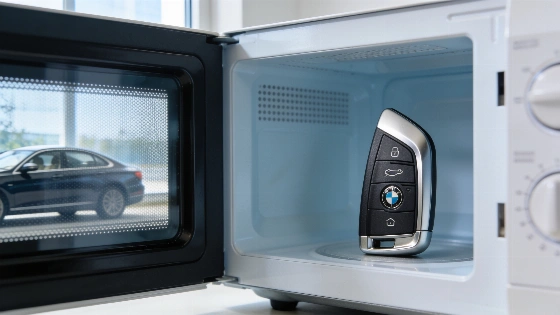
Placing car keys inside a microwave has become a viral tip to block keyless entry signals and deter relay thefts. But experts warn this home hack carries real risks and recommend safer, purpose-built alternatives for protecting modern vehicles.
When drivers return home and slip their car keys into the microwave, it’s not forgetfulness—it’s a deliberate attempt to outsmart thieves. The trend, now widespread on social media, targets a vulnerability in vehicles equipped with keyless entry and start systems. These systems allow a car to unlock and start when the key fob is nearby, but they also open the door to a sophisticated form of theft known as relay attacks.
Microwaves, with their metal-lined interiors and mesh doors, are designed to contain electromagnetic waves during cooking. When switched off and closed, they can also dampen certain wireless signals, making them an improvised shield for key fobs. The idea is simple: by storing the key inside, its signal is less likely to be detected from outside the house, reducing the risk of thieves intercepting and relaying it to the car parked outside.
How Relay Attacks Work
Relay attacks exploit the convenience of keyless systems. Criminals use two devices: one captures the key’s signal from inside the home, while the other transmits it to the car. The vehicle, fooled into thinking the key is nearby, unlocks and starts—no broken glass, no forced locks. According to the German automobile club ADAC, which tested over 800 keyless models, only about 15% resisted this type of attack as of January 2026. The Spanish traffic authority DGT has also flagged keyless entry as a major target for car thieves.
The Microwave Trap: More Risk Than Reward
While the microwave trick may seem clever, it’s far from foolproof. The effectiveness depends on the appliance’s condition, how tightly it seals, and the frequency used by the key. There’s no guarantee the signal is fully blocked. Worse, the method introduces a new hazard: if someone unknowingly turns on the microwave with the keys inside, the metal components, battery, and electronics in the fob can spark, melt, or even start a fire. Appliance manufacturers like Bosch warn that metal objects can cause electrical arcs, damage the microwave, and pose a real fire risk. Even when the microwave is off, it’s not a safe or reliable storage spot.
Safer Alternatives: Faraday Pouches and Smart Habits
Security experts and authorities recommend using Faraday pouches or boxes—special containers designed to block wireless signals. These should be checked regularly for wear, as their protective lining can degrade over time. It’s also wise to keep keys away from doors and windows, disable the wireless signal if your car allows, and use a physical steering lock for added security. Some key fobs offer a sleep mode that stops transmitting when left still, and newer systems using ultra-wideband (UWB) technology can more accurately verify the key’s proximity.
Everyday Security and Emergency Risks
While creative, the microwave method is a shortcut that can backfire. As car theft techniques evolve, so must the ways drivers protect their vehicles. For those concerned about home safety, it’s worth noting that even small habits—like where you leave your keys—can have unexpected consequences. In fact, as highlighted in a recent report on why leaving keys in the door overnight can hinder emergency response, everyday choices about key storage can impact both security and safety in ways most people never consider.
Ultimately, the best defense against relay theft is a combination of technology and vigilance. Purpose-built signal blockers, careful key placement, and staying informed about your vehicle’s features offer more reliable protection than any kitchen appliance ever could.