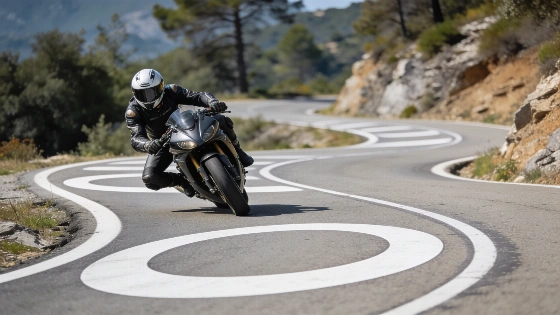
Large white ellipses have been painted on risky bends in Catalonia to help motorcyclists maintain safer positions. Early data shows most riders follow these markings, but their impact on accident rates remains under review.
On the winding roads of the Collada de Toses and the B-124 in Catalonia, a new kind of road marking has caught the attention of motorcyclists: large white ellipses placed near the center line of dangerous curves. These markings, introduced in October 2025, are designed to guide riders away from the most hazardous part of the lane and help keep both the motorcycle and the rider's body within the safety of their own side.
According to the Servei Català de Trànsit, an initial study released on June 2, 2026, found that 65% of observed motorcyclists followed the recommended path indicated by these ellipses. The markings are not intended to dictate speed or replace existing road signs. Instead, they serve as a visual cue, encouraging riders to approach curves with more margin from the center line, reducing the risk of crossing into oncoming traffic when leaning into a turn.
How the Markings Work
The white ellipses are positioned on the inside of selected high-risk curves, close to the central road line. Motorcyclists are advised to ride on the side of the ellipse farthest from the center, without crossing over the marking itself. This subtle shift in trajectory is meant to keep the bike in a safer zone and minimize the chance of the rider's body entering the opposite lane during a lean. The system is purely advisory and does not override the need for careful speed management, attention to road conditions, or adherence to vertical signage.
If a rider notices the markings too late, experts recommend not making sudden corrections or focusing on the paint, but instead prioritizing stability and available space. The markings are intended as an additional safety tool, complementing advanced rider assistance systems (ADAS and ARAS), but not replacing the fundamentals of safe riding technique.
Origins and Expansion
The first documented trial of these markings in Spain began in October 2019 on the BV-2115 near the Foix reservoir. The Servei Català de Trànsit monitored 22 curves over a 3.7-kilometer stretch, using cameras to analyze rider trajectories. The project expanded in 2025 to the Collada de Toses and the B-124 between Sant Llorenç Savall and Calders. In the B-124 trial, 236 out of 363 observed motorcyclists respected the recommended line over a 25-day period. While these figures suggest a positive behavioral shift, authorities caution that at least two years of data are needed to determine any real impact on accident rates.
Not a National Standard
Since July 2025, Spain's official road sign catalog includes the M-8.4 marking for motorcyclists and cyclists, which warns of especially dangerous curves and highlights areas of the lane to avoid. However, the M-8.4 consists of pairs of short bars near the center line, not the large ellipses used in the Catalan trials. The two designs share a preventive aim but differ in appearance and are not interchangeable. The M-8.4 is classified as non-mandatory and requires technical reports and additional signage if used in pilot projects. There is currently no evidence of a nationwide rollout of the Catalan-style ellipses.
International Experience and Limitations
Some of the optimism around these markings comes from Austria, where similar experiments in the Tirol region reportedly led to an 80% reduction in motorcycle accidents on certain curves, according to the DGT's official magazine. However, a separate analysis by the Austrian KFV found a 42% drop in injury crashes and a significant increase in riders choosing safer lines, but also noted that results varied and sample sizes were small. These findings cannot be directly applied to Spanish roads without further study.
In 2025, Spain recorded 304 motorcyclist fatalities, with 232 deaths occurring on conventional roads. Vulnerable users accounted for 40% of all road deaths, underscoring the ongoing need for both preventive measures and enforcement, such as the use of unmarked police motorcycles in high-risk areas.
While the early response to Catalonia's white ellipses is promising in terms of rider behavior, their true effect on safety will only become clear with time and continued analysis. For now, the markings represent a cautious step toward reducing risk on some of the region's most challenging roads.