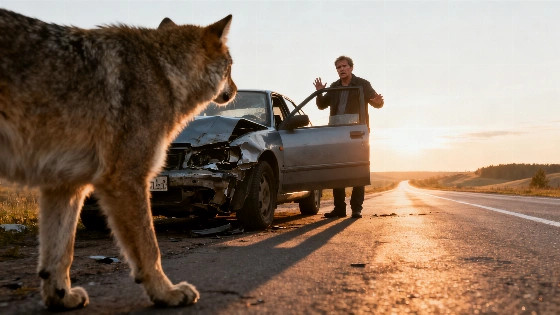
Collisions with animals on Spanish roads have reached a record high, with wild boar and roe deer responsible for nearly three-quarters of all incidents. The latest DGT report highlights a growing safety challenge, especially outside major highways.
In 2024, wild boar and roe deer were involved in 26,705 road accidents on Spanish interurban roads, according to the latest figures from the Dirección General de Tráfico (DGT). This marks a significant shift in road safety, as these two wild species now account for almost three out of every four animal-related crashes, far outnumbering incidents involving domestic animals like dogs and cats.
The DGT report, compiled by the National Road Safety Observatory, recorded a total of 36,087 animal-involved accidents this year, excluding data from Catalonia and the Basque Country. This represents a 3% increase over the previous year, with 549 of these incidents resulting in casualties—eight fatalities and 58 people requiring hospital treatment.
Wildlife at the Center of the Problem
Wild boar remain the leading cause of animal-related accidents, with 15,049 cases—42% of the total—reflecting a 4% rise from last year. Roe deer follow closely, involved in 11,656 accidents, or 32% of the total, and showing a 6% year-on-year increase. Combined, these two species are responsible for a new accident every 20 minutes on Spanish roads.
By contrast, dogs were involved in 3,058 accidents, while deer accounted for 1,954. Overall, wild animals were implicated in 31,421 accidents—87% of all animal-related incidents—while domestic animals were involved in just under 4,000 cases, with dogs being the most common among them.
Risks Highest on Conventional Roads
The vast majority of these accidents—31,673, or 88%—occurred on conventional interurban roads, rather than on high-capacity highways or motorways. These stretches, often passing through rural, forested, or agricultural areas, see more frequent animal crossings and present greater risks for drivers.
Nearly all incidents involved vehicles striking animals directly, with 35,487 cases (98% of the total) classified as animal collisions. Passenger cars were the most frequently involved vehicles, appearing in 31,560 accidents, far outnumbering vans and trucks.
Temporal patterns also emerged: Sundays saw the highest number of accidents (5,632), and the hour between 22:00 and 22:59 registered the most incidents (4,277). November and December were the peak months, with 3,855 and 3,848 accidents respectively.
Regional Hotspots and Black Spots
Castilla y León led all regions with 12,292 animal-related accidents—34% of the national total. Galicia (5,723) and Aragón (3,328) followed. At the provincial level, Burgos recorded the most incidents (2,350), ahead of León (2,179).
The report also identified specific danger zones. The most accident-prone one-kilometer stretch was on the OU-525 in Ourense, between kilometer points 226.9 and 227.9, with 15 accidents. Over five kilometers, the CM-2011 in Guadalajara, between kilometers 5.9 and 10.9, saw 38 incidents.
Efforts to Reduce Animal Collisions
In response to the rising trend, the DGT has released a new guide aimed at reducing animal-related accidents. Plans are underway to integrate real-time alerts about high-risk stretches into the DGT 3.0 navigation system, allowing drivers to receive warnings when approaching areas with frequent wildlife crossings.
As wildlife populations expand and their habitats intersect more with road networks, the challenge of preventing animal collisions is likely to remain a key issue for Spanish road safety policy. The latest data underscores the need for targeted measures, especially on rural roads where the risk is highest.