A fast-moving wildfire in Vall d’Uixó, Castellón, triggered a desperate effort on Saturday, 25 July 2026, as flames shifted direction and threatened homes and farms. For Luis Alcón, a 68-year-old cattleman who has witnessed three major fires in his lifetime, this was the first time a blaze reached the very edge of his property. The fire forced Alcón and his family to race to rescue their livestock as the situation deteriorated within minutes.
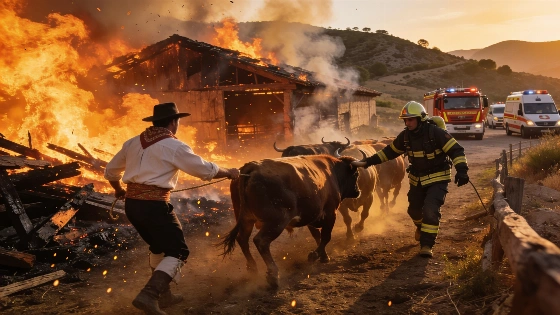
Initially, Alcón believed his home and animals were safe, but a warning from local urban planning councillor Vicente Pitarch changed everything. With the wind expected to turn at 7 p.m., Alcón quickly called a friend who drove a truck to help evacuate the bulls from the lower corral. By the time the truck arrived, the fire was already advancing. In just ten minutes, flames engulfed the farm, leaving Alcón’s family, including his granddaughter, and four workers with little time to act. The terrified animals resisted evacuation as smoke and heat intensified, complicating the rescue.
Firefighters waited at the farm entrance to assist, but as soon as the animals were loaded, fire cut off the escape route. Alcón and his team had to abandon the lower corral, leaving several oxen behind. With the basic road blocked, they searched for an alternative route to safety in a neighboring municipality. The ordeal worsened when one worker suffered a panic attack, and the group had to handle through the smoke. Firefighters led them out, clearing a path through the burning field.
After days of uncertainty, Alcón returned to his devastated property on Tuesday. Contrary to his fears, some of his oxen had survived, grazing on a small patch of green surrounded by ash. The fire had stopped at the edge of the area the animals had kept clear by grazing. It offered a rare glimpse of ability to recover amid widespread destruction.
During the emergency, the fire spread across the Serra d’Espadà and affected 18 municipalities; authorities evacuated approximately 16,000 people. Alcón’s experience brought the consequences into sharp focus at farm level: an abrupt shift in fire behavior could put livestock and workers at risk within minutes, while escape routes could quickly disappear.
At the time of the rescue, the wildfire was reported to have a 72-kilometer perimeter and to have affected nearly 8,500 hectares. Later assessments placed the burned area at approximately 9,568 hectares, including about 3,688 hectares, roughly 12%, within the Sierra de Espadán Natural Park. RTVE subsequently described it as the Valencian Community’s third-largest wildfire of the previous decade. New flare-ups in Artana and l’Alcúdia de Veo on Tuesday renewed residents’ concerns as the emergency unfolded. The disaster echoes recent incidents elsewhere in Spain, including the mass evacuations and damage reported in Zaragoza province, where phased returns began only after basic services were restored, as detailed in coverage of the Orés wildfire recovery.
Authorities later classified the Vall d’Uixó fire as intentional, RTVE reported. The investigation remained open nearly three months after it began as investigators sought to identify the person responsible. That classification concerns the suspected origin of the blaze; the investigation was still ongoing at the time of the report.
The fire’s effects extended beyond burned woodland and damaged infrastructure. In October, the Generalitat Valenciana began recovery work, including the reconstruction of two nesting platforms for Bonelli’s eagle, an endangered species in the Valencian Community. The Generalitat’s environmental agents carried out the work in coordination with its wildlife and Natura 2000 service. A broader €4.2 million recovery program covered forest and trail restoration, alongside repairs to the CV-219 and CV-223 roads, with safety measures also planned in affected areas.
Recovery also included support for the agricultural sector. A €9 million national assistance package was approved to supplement Agroseguro compensation for insured farms damaged in the Valencian fires. Reported maximum payments included €3,500 per hectare for fruit trees and €1,900 per hectare for citrus plantations; those rates applied to the specified crops and do not describe compensation for Alcón’s livestock.
The risks did not end when the flames subsided. WWF warned that intense rainfall over burned ground can wash ash into rivers, increasing runoff and the risk of flooding. Alfondeguilla and Alcudia de Veo, among the municipalities affected by the fire, were identified for heightened monitoring after rain. The European Forest Fire Information System reported that by 19 October 2026, about 301,299 hectares had burned across the wider monitored area, 139% above the average for the previous decade.
Wildfires are a recurring threat in Spain’s Mediterranean regions, often fueled by dry conditions and sudden changes in wind direction. The rapid escalation in Vall d’Uixó highlighted the vulnerability of rural communities and the role of emergency services. The events in Castellón showed the risks local authorities face as they protect residents and farmers in a changing environment.