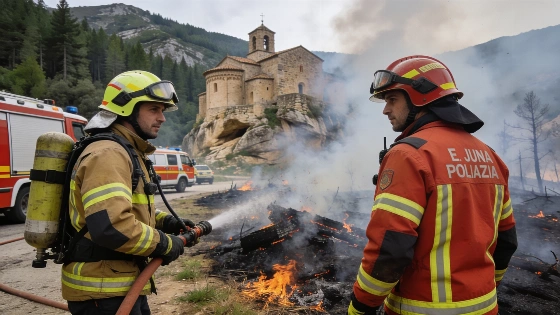
A major wildfire in Huesca has led to the evacuation of 830 residents across 16 towns. The flames now threaten the San Juan de la Peña monastery, a key symbol of Aragon’s heritage. Authorities have removed royal remains and valuable artifacts.
The wildfire that erupted in the Peñas de Riglos area of Huesca has escalated sharply, forcing the evacuation of 16 municipalities and leaving 830 people displaced. Overnight, four more villages were cleared as the fire advanced, with emergency services battling to contain the flames amid shifting winds and unpredictable conditions.
On Thursday, the situation became critical when the fire surrounded both the old and new San Juan de la Peña monasteries. These historic sites, considered the birthplace of the Kingdom of Aragón, faced direct threat as emergency teams rushed to protect the complex. The Unidad Militar de Emergencias (UME) was deployed to safeguard the area, carrying out two urgent transfers: first, rescuing the ceremonial attire of the Conde de Aranda, and then relocating the remains of eight medieval monarchs whose tombs are housed in the monastery.
Authorities described the hours as extremely tense, with both the 11th-century monastery carved into the mountain and the later 17th-century baroque building at risk. Firefighters conducted a controlled burn to shield the site, but the threat remains. Roberto Bermúdez de Castro, regional councillor for Finance, Interior and Public Administration, confirmed that both monasteries were in danger for several hours and that the situation required immediate and coordinated action.
The fire has already destroyed 8,000 hectares, affecting towns including Santa María de la Peña, Triste, La Peña Estación, Yeste, Botaya, Alastuey, Larués, Bailo, Villalangua, Salinas de Jaca, Ena, Centenero, Arbués, Santa Cruz de la Serós, Binacua, Osia, and a local campsite. The rapid spread of the blaze, especially after a sudden change in wind direction, caught many by surprise and complicated firefighting efforts. For Friday, 30 aerial units from the Government of Aragón, the Ministry for Ecological Transition, UME, and teams from Navarra, La Rioja, Catalonia, Comunidad Valenciana, and Castilla y León are expected to continue operations, supported by extensive ground crews.
Police have arrested a 28-year-old man suspected of starting the fire. Investigators found construction materials at the ignition point, believed to be linked to recent roadworks on the A-132, which may have contributed to the outbreak. The Guardia Civil’s environmental unit, Seprona, is leading the inquiry.
As the emergency unfolded, the removal of royal remains and heritage items from San Juan de la Peña echoed similar actions reported in recent days. For further details on the evacuation of historic relics and the ongoing firefighting response, see the coverage on the protection of San Juan de la Peña’s royal heritage during the wildfire.
San Juan de la Peña is one of Aragón’s most significant monuments, with its origins dating back to the 11th century. The site has survived multiple fires throughout history, prompting the construction of the newer monastery in the 17th century. The current threat highlights the vulnerability of Spain’s cultural heritage to extreme weather and environmental hazards. Wildfires have become increasingly frequent and severe in recent years, often fueled by prolonged drought and high temperatures. The coordinated response from regional and national authorities underscores the importance of protecting both residents and irreplaceable historical sites during such crises.