

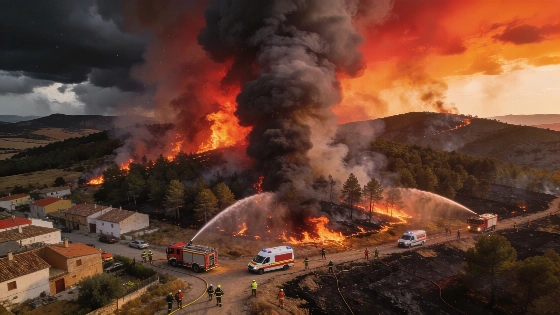
A major wildfire in Zaragoza province has destroyed over 15,000 hectares. Several towns remain at risk as emergency services intensify efforts. Authorities focus on protecting residents and updating containment strategies.
More than 15,400 hectares have been scorched in the Las Cinco Villas region of Zaragoza after a wildfire that began Wednesday near Orés continued to spread overnight. The Government of Aragón reported early this morning that the fire's left flank, particularly in sectors 5 and 1, saw some containment progress due to milder northern winds. Despite these gains, the situation remains volatile, with multiple municipalities still under threat and emergency teams rotating shifts to maintain a constant response.
Throughout the night, the towns of Longás, Isuerre, and Lobera de Onsella were placed on standby for possible preventive evacuations. On Friday, flames breached the outskirts of Luesia, putting its urban center at risk and crossing the road between Luesia and Uncastillo at several points. According to the regional interior minister, this is the most challenging wildfire Aragón has faced in recent years, citing unpredictable winds and difficult terrain as key obstacles. Authorities emphasized that defending Luesia was a priority, with significant resources concentrated there to prevent the fire from reaching the town center. The day was marked by shifting fire fronts and repeated flare-ups, but officials confirmed that the municipality was successfully protected.
Approximately 450 personnel and 22 aerial units were deployed on Friday, supported by ground teams from the Government of Aragón, the Ministry for the Ecological Transition and Demographic Challenge, the Military Emergency Unit (UME), Guardia Civil, firefighters, Civil Protection, Red Cross, emergency medical services, social services, and collaborating autonomous communities. The UME alone contributed over 330 personnel, while 18 government crews and additional resources from local and national agencies joined the effort. The top priority remains safeguarding the population and anticipating any sudden changes in the fire's behavior, officials stated.
During a meeting of the CECOPI emergency coordination committee, authorities also discussed temporary housing solutions for residents displaced since Wednesday. Many spent a third consecutive night at the Ejea De los Caballeros sports center, though specific relocation options have yet to be detailed.
Elsewhere in Aragón, the wildfire near Plan in Huesca province slowed overnight as humidity and lower temperatures helped limit its advance. However, authorities warned that burning debris continues to roll down slopes, potentially fueling uphill runs as conditions change. The right flank and head of the fire are currently less concerning, as they move toward areas with little vegetation, but efforts are focused on preventing the left flank from reaching a ravine that could accelerate its spread.
Meanwhile, the fire near Fiscal is considered stabilized, but aerial operations will continue due to its high potential, especially with temperatures expected to rise on Saturday. The Government of Aragón noted that ground access remains nearly impossible, complicating containment efforts.
This crisis follows a series of severe wildfires in Spain in recent years. For context, a previous incident in Orés led to the destruction of over 12,000 hectares and forced evacuations in several towns, as detailed in this report on earlier wildfire evacuations in Zaragoza province. Such events highlight the ongoing challenges posed by extreme weather and complex terrain in managing large-scale fires across the region.
Wildfires have become an increasingly frequent threat in Spain, particularly during periods of drought and high temperatures. The combination of strong winds, dry vegetation, and rugged landscapes often complicates firefighting operations. In response, Spanish authorities have invested in expanding aerial firefighting fleets and improving coordination between regional and national emergency services. The situation in Las Cinco Villas underscores the importance of rapid response and community preparedness as climate conditions continue to drive wildfire risks across the country.



