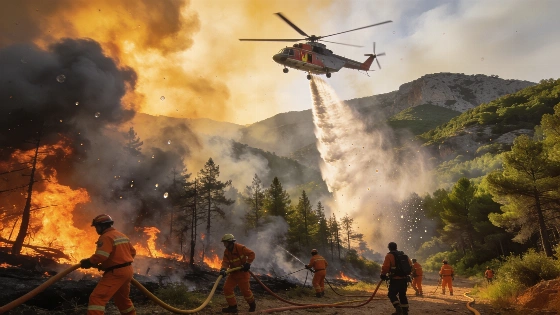
A fast-moving wildfire broke out on Tuesday afternoon in the Rubió area of Barcelona province, prompting an urgent response from emergency services. The fire started near the municipal boundary of Castellfollit del Boix and has scorched approximately 27 hectares of forest, information from provisional estimates from the Agentes Rurales. The affected zone is remote and difficult to access, complicating the work of nearly 90 firefighters deployed to the scene.
Firefighting teams mobilized 38 ground vehicles and ten aircraft to contain the blaze, first reported at 16:27 after smoke was spotted near the Can Massana hermitage. As the operation escalated through the afternoon, authorities expected additional support from a high-capacity water bomber provided by Spain’s Ministry for the Ecological Transition and the Demographic Challenge. The left flank was advancing most aggressively, but crews focused on the right flank, which posed a greater operational risk because of wind conditions.
Local Agrupacions de Defensa Forestal (ADF) and area farmers joined the effort, using tractors to create protective barriers and slow the fire’s progress. Difficult terrain and strong winds complicated suppression, while the sparsely populated location initially limited the immediate threat to homes. The risk of further spread remained impressive amid dry conditions and the potential for rapid changes in the weather.
The response came during a year of unusually heavy demand on Spain’s aerial firefighting system. By September 21, 2026, the Ministry for the Ecological Transition and the Demographic Challenge had recorded 498 fires addressed with state aerial resources, according to figures reported by Europa Press. The crews flew 2,659 sorties and logged 10,067.19 flight hours, while aircraft made 50,259 water drops. EFE Verde later reported that nearly 280,000 hectares of forest had burned nationwide in 2026, about 2.5 times the average for the previous decade. Its account also said 54 of the 56 aircraft planned for the summer campaign were ultimately available. That included eight operational amphibious aircraft, down from ten initially planned.
Just a day before the Rubió fire, emergency services were stretched by simultaneous wildfires in Aiguamúrcia, Tarragona, and Lladurs, Lleida. National aerial resources supplement regional firefighting services during major incidents, including when fires occur simultaneously or terrain makes ground access difficult. The situation in Rubió also echoes events elsewhere in Spain, such as the Los Gallardos fire in Almería, where containment efforts and victim identification drew national attention. For more on how authorities managed that crisis, see the detailed coverage at this report on the Los Gallardos wildfire response.
Wildfires are a recurring threat in Spain, particularly during summer, when dry conditions and heat can heighten the danger. Professional firefighters worked alongside aerial units, with local forest-defense groups and farmers also joining the response in rural and forested areas. The national figures reported for 2026 reflect the wider pressure on firefighting resources. In Rubió, crews focused on the fire’s changing behavior and the immediate risks posed by wind and terrain.