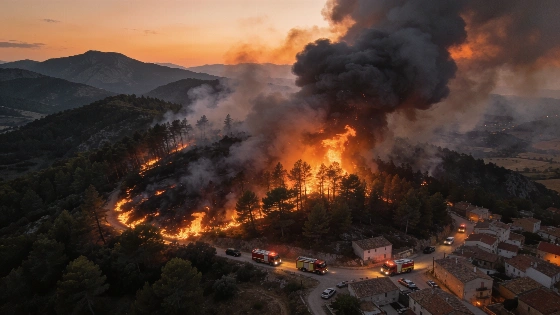
A fast-moving wildfire in Sierra de Espadán has led to the evacuation of over 15,000 people. Fourteen towns and several neighborhoods are cleared as emergency crews battle the flames. Authorities warn of extreme conditions.
More than 15,000 residents and visitors were forced to leave their homes overnight as a major wildfire swept through the Sierra de Espadán natural park in Castellón. The blaze, which began in a neighborhood of La Vall d’Uixó, quickly spread due to intense westerly winds exceeding 50 km/h, high temperatures, and severe drought. Emergency services faced significant challenges as the fire advanced unchecked, prompting the evacuation of 14 municipalities and parts of two others.
Firefighters described the situation as overwhelming, noting that the scale and intensity of the flames at times surpassed the capacity of any firefighting service. The Consorcio de Castellón shared dramatic footage of the fire, highlighting the extraordinary force of nature at play. As of Sunday morning, aerial firefighting units resumed operations, hoping that a forecasted drop in temperatures and wind speed would aid containment efforts. No official estimate of the affected area has been released yet.
The evacuations impacted a wide area, including La Vilavella, Artana, Eslida, Tales, Artesa (a district of Onda), Aín, Alcudia de Veo, Alfondeguilla, Sueras, Torralba, Villamalur, Fuentes de Ayódar, Chóvar, and two neighborhoods each in La Vall d’Uixó and Betxí. Many mountain homes scattered throughout the region were also cleared. Five of the evacuated municipalities—Eslida, Chóvar, Aín, Alcudia de Veo, and Fuentes de Ayódar—are entirely within the protected park, while four others are partially included in this vital green area of the Valencian Community.
According to regional president Juanfran Pérez Llorca, a significant number of evacuees were staying in second homes and have since returned to their primary residences. Others found shelter with relatives or friends, while three sports centers in Nules, Moncofa, and Onda were opened for those needing accommodation, with another planned in Segorbe. Six people required urgent medical attention, three of whom remain hospitalized for smoke inhalation at La Plana hospital. Several roads connecting the affected towns have been closed as a precaution.
Local authorities also arranged for dependent residents from the hardest-hit areas to be relocated to a care facility in Borriana. Tania Baños, mayor of La Vall d’Uixó, emphasized that the safety of residents remains the top priority, praising the community’s response and expressing concern for the loss to the region’s way of life. The fire’s origin remains under investigation, with multiple ignition points raising suspicions of arson, though this has not been confirmed.
This incident follows a pattern of severe wildfires in Spain in recent years, often exacerbated by extreme weather and dry conditions. For context, similar mass evacuations and emergency responses were reported during previous wildfires in Castellón, as detailed in coverage of earlier large-scale evacuations in the region. The Sierra de Espadán park, stretching from the mountainous interior of Castellón to near the Mediterranean coast, is one of the most significant natural reserves in the Valencian Community, making the current fire a major environmental and social concern.
Spain’s wildfire season has become increasingly unpredictable, with authorities urging residents to remain vigilant and follow official instructions. The full impact on local communities, infrastructure, and the natural environment will become clearer as firefighting efforts continue and conditions evolve.