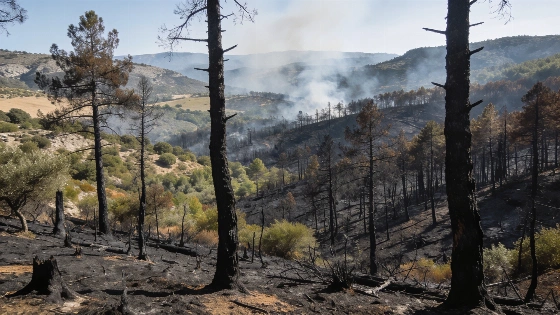
Spain leads the EU in burned forest area this year. Fires in Castilla y León and La Mierla remain active. Authorities report evacuations, property loss, and ongoing emergency response.
Spain is facing its most severe wildfire season in years, with nearly 120,000 hectares of forest already burned—double the area affected just two weeks ago. According to the European Forest Fire Information System, the country now tops the EU in forest area lost to fire in 2026. The situation remains critical in Castilla y León, where nine wildfires are still active, and in La Mierla (Guadalajara), where the largest blaze has entered a stabilization phase after devastating around 32,000 hectares.
Emergency services have been stretched across multiple regions. In Segovia, the fire near Brieva is showing signs of improvement after burning approximately 3,000 hectares. Meanwhile, the Unidad Militar de Emergencias (UME) was deployed to Burgohondo (Ávila), where 100 residents were evacuated as the fire threat reached level 2, raising concerns about potential damage to the town itself.
In Zamora, authorities have managed to contain the flames near Rábano de Aliste, allowing the local emergency committee (Cecopi) to lift the confinement order. However, in León, the UME remains on alert, and precautionary evacuations have taken place in Castropodame, Turienzo Castañero, and San Pedro Castañero due to the risk of the fire spreading toward Torre del Bierzo. Heavy machinery, ground crews, and aerial support continue to operate in the area.
The fire in Almorox (Toledo), which crossed into the Community of Madrid on Thursday, has been brought under control and downgraded to level 1 severity after burning about 1,000 hectares. The incident forced the evacuation of several residential areas and destroyed at least 26 homes—20 of them in Villa del Prado (Madrid), where 225 plots and 20 vehicles were also affected. In Toledo province, 26 people remain displaced, with six homes and several vehicles damaged.
Elsewhere, the fire in Selas (Guadalajara) has been contained after consuming more than 2,000 hectares. In Almería, the Los Gallardos fire, which tragically claimed 13 lives, spread at a rate four times faster than typical wildfires, according to the Junta de Andalucía. In Huelva, around 130 firefighters are still working to secure the perimeter of the El Cerro del Andévalo blaze, though aerial resources are no longer needed after a successful night of containment.
Other regions are also grappling with ongoing fires. The Ejulve fire in Teruel has stabilized, while the Plan fire in Huesca remains active but is not advancing, thanks to reinforced control lines. The La Mierla fire, which has affected Soria, has been downgraded to severity level 1, and residents evacuated from the Retortillo care home have been allowed to return.
Spain's Minister for Ecological Transition, Sara Aagesen, reported that wildfires have already destroyed 108,000 hectares nationwide—four times the area lost by this point in 2025. The scale of the crisis has prompted Prime Minister Pedro Sánchez to visit the affected areas in Guadalajara, where he called for a national pact to address the climate emergency and praised the efforts of emergency workers and the media.
As the country battles these fires, the risk of further incidents remains high due to ongoing heatwaves and dry conditions. The rapid spread and intensity of recent blazes have highlighted the vulnerability of urban-forest interface zones, which authorities describe as particularly dangerous. The situation echoes other recent emergencies, such as the gas explosion and fire at the Plaça de Sants metro works in Barcelona, which also required a large-scale emergency response and led to significant disruption, as detailed in this related report.
Spain's wildfire crisis in 2026 underscores the growing challenges posed by climate change and the need for coordinated action at both regional and national levels. The ongoing response involves not only firefighting but also evacuation planning, property protection, and support for affected communities. As the summer progresses, authorities remain on high alert, monitoring conditions and preparing for potential new outbreaks.