A viral story claims that over 55,000 used tennis balls from Wimbledon become shelters for harvest mice each year. In reality, the original project was limited, and most balls are now sold or recycled. Here’s what actually happens to Wimbledon’s used balls.
When Wimbledon ends each summer, tens of thousands of tennis balls have bounced their last on the famous grass courts. Recently, a viral claim suggested that more than 55,000 of these used balls are transformed annually into shelters for field and harvest mice. The reality, however, is far less sweeping—and more nuanced—than the story suggests.
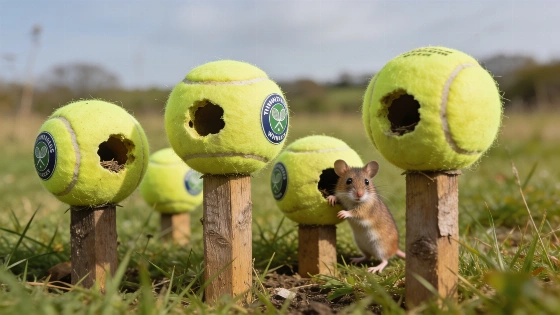
The origin of this claim dates back to a real initiative from 2001. That year, Wimbledon partnered with The Wildlife Trusts to repurpose a small number of used balls as nesting sites for the harvest mouse (Micromys minutus), one of Europe’s smallest rodents. The method was simple: a hole was cut in each ball, which was then mounted on a post at a height that protected the mice from predators. The project aimed to support local conservation efforts, but its scale was modest. According to documented reports, only 350 balls were donated for this purpose, distributed among wildlife organizations in Avon, Glamorgan, and Northumberland.
The confusion stems from the annual supply figures. In 2026, for example, Wimbledon received 54,250 new balls from Slazenger, with the total often rounded up to 55,000 in public references. However, this number reflects the tournament’s supply, not the number of balls donated to wildlife projects. Most used balls are now sold to fans and clubs, with proceeds—£44,000 in 2026—supporting the Wimbledon Foundation’s charitable programs. The remainder enters a recycling system managed by the Lawn Tennis Association (LTA), which processes the balls into products like flooring tiles and acoustic insulation.
The Real Mouse Refuge Project
The original mouse shelter initiative was never a large-scale or recurring program. In 2001, some of the 36,000 balls used at Wimbledon were set aside for the project, but only a fraction were actually converted into refuges. The viral claim that tens of thousands of balls become mouse homes each year is not supported by any official documentation or recent activity. As fact-checkers at Snopes noted in July 2025, the story is outdated and misrepresents the scale of the original effort.
What Happens to Wimbledon’s Used Balls Now?
Today, Wimbledon’s approach is focused on resale and recycling. Used balls are sold at the Southern Village shop, with net proceeds going to charity. The LTA’s Circularball program collects used balls from clubs and tournaments across Britain, processing both the felt and rubber into new materials. This industrial recycling offers a practical solution to the environmental challenge posed by tennis balls, which can take up to 300 years to decompose in landfill.
While the idea of giving every used ball a second life as a wildlife shelter is appealing, the reality is that such projects require careful planning, monitoring, and habitat management. The harvest mouse, for example, needs specific environments—tall grasses, hedgerows, and reed beds—to thrive. Artificial refuges can help in targeted conservation efforts, but they are not a substitute for broader habitat protection.
The Harvest Mouse: Conservation Context
The harvest mouse is Britain’s smallest rodent, weighing just 4–6 grams and measuring 5–7 centimeters in length. Its populations are classified as near threatened in Great Britain, vulnerable in Wales, and critically endangered in Scotland, largely due to habitat loss and changes in agricultural practices. Conservationists emphasize that while artificial shelters can support local populations, they must be part of a coordinated strategy that includes habitat restoration and ongoing monitoring.
In summary, Wimbledon’s used tennis balls do not become mass-produced mouse shelters each year. The original project was real but limited, and today, most balls are either sold for charity or recycled into new materials. The viral story, while rooted in a genuine conservation effort, exaggerates its scale and impact.