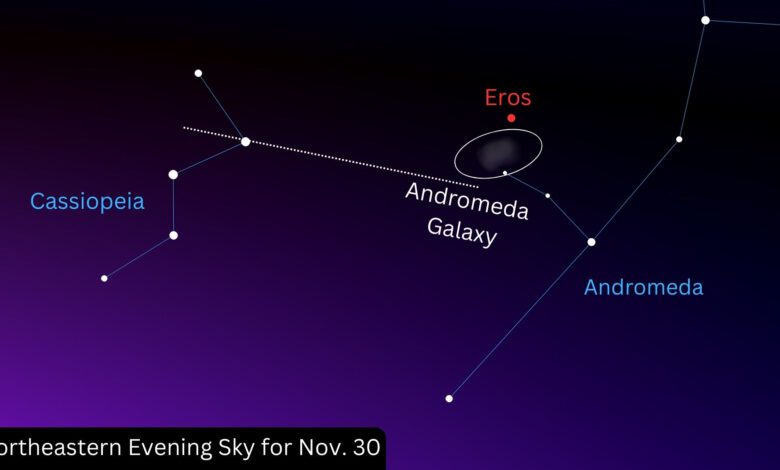
On the evening of November 30, astronomy enthusiasts will have the chance to witness a rare event: the asteroid Eros (433) will pass at its closest distance to the famous Andromeda Galaxy. The Virtual Telescope Project, in collaboration with the Asteroid Foundation, will host a live broadcast of the event. The stream is scheduled to begin at 21:00 Madrid time, and the sky will be observed using state-of-the-art robotic telescopes based in Manciano, Italy. Weather permitting, viewers will see both celestial objects appear in the same field of view.
Organizers promise not just a live feed, but detailed commentary from the project’s founder, Gianluca Masi. He notes that such a close approach of a large near-Earth asteroid to Andromeda is a rare opportunity to showcase the beauty and scale of the Universe, as well as to remind us of the importance of studying minor planets.
A historic encounter: Eros and its path to fame
Asteroid Eros was discovered in 1898 and became the first known object to cross Earth’s orbit. Its study gave rise to an entire field within astronomy. In the 2000s, the American interplanetary probe NEAR Shoemaker was sent to Eros. Not only did it enter into orbit around the asteroid, but it also made the first-ever landing on its surface on February 12, 2001. This achievement marked a breakthrough in the exploration of small bodies in the Solar System.
On the night of November 30, Eros will pass just 60 million kilometers from Earth—considered quite close by cosmic standards. At this moment, it will appear less than two degrees from the core of the Andromeda Galaxy, which is 2.5 million light-years away. Such an alignment is extremely rare and has attracted significant interest from astronomers and skywatchers around the world.
How to see the close approach: tips for observers
Eros is one of the largest near-Earth asteroids, with a diameter of up to 33 kilometers. Thanks to its size, it will shine at about 10th magnitude, making it visible even with a small amateur telescope with an aperture of 60 mm or more. For locating the asteroid and the Andromeda Galaxy, it’s best to use astronomy apps or traditional star charts.
On the evening of November 30, both objects will be high above the eastern horizon. Look for the constellations Cassiopeia and Andromeda as a reference, then use the top three stars of Cassiopeia to aim your telescope at the right part of the sky. Even if you don’t have your own equipment, a live broadcast from Italy will let you enjoy the event in detail.
Why this matters: the importance of minor planets and astronomical observations
Such events are not only impressive in their beauty, but also serve as a reminder of the importance of studying near-Earth objects. Asteroids like Eros are of scientific interest and could pose a potential threat to Earth in the future. Observing them helps us better understand the dynamics of the Solar System and develop methods to protect our planet.
The Andromeda Galaxy, in turn, remains one of the brightest and most easily observable objects outside the Milky Way. Its proximity to Eros on this particular evening is a rare treat for anyone interested in space.
If you want to learn more about the best telescopes and binoculars for stargazing in 2025, check out the latest reviews and expert recommendations. Modern technology is making astronomy accessible to everyone.
RUSSPAIN.COM reports that the Virtual Telescope Project is an international initiative created by astronomer Gianluca Masi. The project brings together a network of robotic telescopes that allow real-time observation of astronomical phenomena from various locations around the world. Thanks to online broadcasts, millions of people can follow rare events without leaving their homes. Virtual Telescope Project regularly organizes educational programs and promotes science to a wide audience.