Unexpected Disintegration of a Celestial Body: Observation Details
In May 2025, experts detected a new object in the sky, later designated C/2025 K1 (ATLAS). It was discovered using a telescope at the El Sauce Observatory in Chile’s Río Hurtado region. The ATLAS project, funded by NASA, is designed for early detection of potentially dangerous space objects that could approach Earth. The system tracks any movements of objects that may pose a threat to our planet.
From the beginning, the comet drew scientists’ attention due to its origin. Calculations showed it formed in the Oort Cloud—a distant region of the Solar System filled with icy bodies. Due to gravitational disturbances, C/2025 K1 ATLAS was ejected from this area and sent toward the inner planets.
Journey Toward the Sun and a Critical Juncture
For several months, astronomers closely monitored the comet’s trajectory. In October, it reached its closest point to the Sun, marking a critical juncture in its fate. Approaching the star caused a rapid spike in surface temperature, leading to intense ice evaporation and dust release. In late October and early November, specialists recorded two bursts in brightness, indicating turbulent activity within the nucleus.
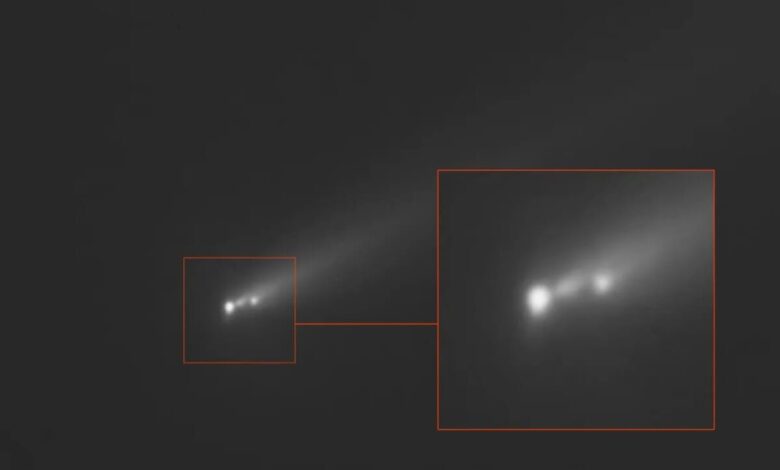
Shortly after these events, it became clear that the comet’s structure had failed to withstand the extreme conditions. Images taken by the virtual telescope show three distinct fragments into which C/2025 K1 ATLAS has broken apart. Such phenomena are rare and always draw scientists’ attention, as they provide valuable insights into the destruction processes of icy bodies near the Sun.
The significance of the discovery for science and future research
The breakup of comet C/2025 K1 ATLAS offers scientists a unique opportunity to study the internal structure of such objects. By analyzing the behavior and composition of the fragments, experts can refine models of comet evolution and assess the potential risks of collisions with Earth. In addition, observing this event will help improve early warning systems for cosmic threats.
This phenomenon also highlights the importance of international cooperation in astronomy. The joint efforts of observatories and the use of advanced technology make it possible to detect even the rarest and most unexpected processes in the Solar System. In the coming months, scientists will continue to monitor the comet’s remnants to gather more data on its destruction mechanisms and the impact on the surrounding space environment.