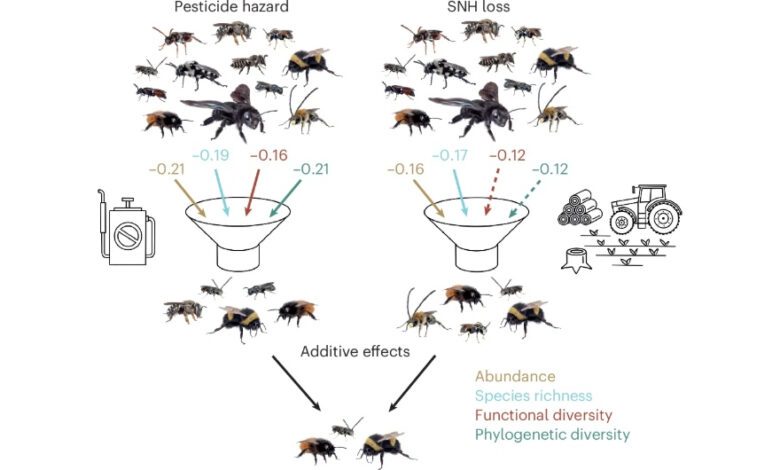
In recent years, Spanish farmers have been increasingly confronted with a troubling trend: the number of bees and other pollinators in the country’s agricultural regions continues to decline, despite efforts to establish buffer zones and semi-natural habitats. Shelterbelts, hedgerows, and hay meadows, intended as refuges for these insects, are not proving effective. The main reason is the relentless impact of pesticides used on neighboring fields.
Bees pollinate not only wild plants, but also key crops such as grapes, sunflowers, olive trees, and coffee. Their role in Spain’s agricultural economy is hard to overstate. However, climate change, air pollution, light pollution, and most importantly, chemical treatment of fields are driving pollinator populations to shrink at an alarming rate.
Buffer zones
In an effort to halt this decline, Spanish farmers and environmentalists are introducing semi-natural areas—sections where intensive agriculture is avoided. These include shelterbelts along fields, hedgerows, shrub plantings, and hay meadows. The idea was that these zones would serve as a kind of shield for bees, protecting them from harmful agrochemicals.
However, recent studies conducted across Europe, Africa, and North America have shown that even when semi-natural habitats make up 80% of the landscape, it’s still not enough. Pesticides used on fields seep into buffer zones, reducing bee populations and diversity. Wind spreads chemicals, and even the smallest doses can disrupt insects’ orientation and memory.
The Pesticide Threat
In Spain, where agriculture is a major sector of the economy, the problem is especially acute. Dozens of types of pesticides, herbicides, and fungicides are used on the country’s fields. Analysis of data on 910 bee species across 681 fields revealed that chemical treatment not only reduces the number but also the species, phylogenetic, and functional diversity of pollinators.
Even when flowering buffer zones are present, fields remain attractive to bees—with large quantities of uniform flowers gathered in one place. But this is exactly where danger lurks: pesticides settling on plants cause disorientation and death among insects.
Hidden Consequences
Many believe that developing beekeeping can offset the decline of wild pollinators. However, the reality is quite the opposite. In some regions, such as the island of Giannutri off the coast of Italy, large-scale honeybee farming has pushed out local species. Honeybees have proven more competitive, effectively depleting the food resources of wild bees and bumblebees, leading to their disappearance.
Similar trends are already being observed in certain provinces of Spain. Environmentalists warn that without a comprehensive approach—including reducing pesticide use and expanding semi-natural habitats—protecting pollinators will not be possible. Only a combination of these measures offers a chance to restore their populations.
The Spanish context
In recent years, autonomous communities such as Andalucía, Valencia, and Cataluña have implemented programs to create ecological corridors and restore traditional landscapes. However, experts note that without revising agrochemical policies and tightening controls on pesticide use, these measures will have limited impact.
The issue of pollinator preservation extends beyond ecology—it’s directly linked to the country’s food security. Declining bee populations are already affecting crop yields and the quality of agricultural products. Farmers are being forced to seek alternative plant protection methods, but so far, with little success.
In case you didn’t know, Annina Knauer is a leading expert at the Swiss agricultural research center Agroscope, whose work has formed the basis for modern pollinator conservation approaches in Europe. Her research is used in the development of agroecological programs in Spain and other EU countries. In recent years, Agroscope has been actively collaborating with Spanish universities and agricultural associations, introducing innovative methods for monitoring and protecting bees.