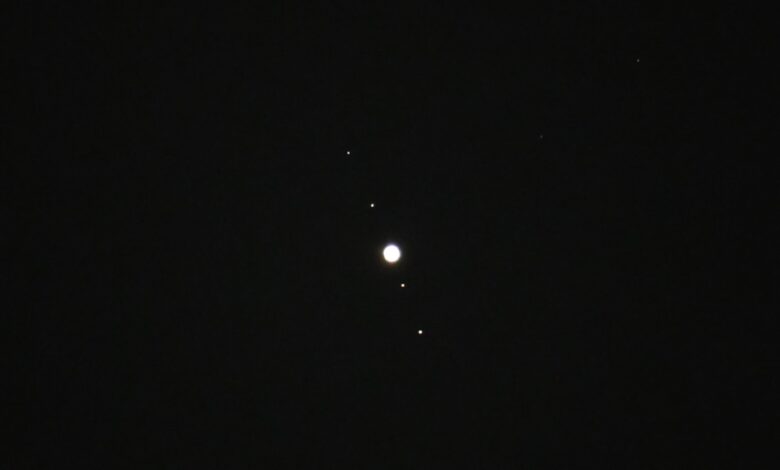
On the night of January 9 to 10, 2026, the sky above the eastern horizon will be illuminated by an unusually bright light—Jupiter is taking center stage. During these hours, the giant planet will reach opposition, meaning it will be at its closest point to Earth. For astronomers and stargazers alike, this event is a true gift: Jupiter will not only be closer, but also noticeably brighter than usual. Its glow will outshine even the brightest stars, and telescopes will reveal new details in its cloud bands.
This time, Jupiter will be set among the stars of the Gemini constellation, with the famous Orion and the bright Capella nearby. From sunset on January 9, the planet will appear in the east, and by midnight, it will become the most prominent point in the sky. All night long, it will slowly ascend before sinking toward the western horizon at dawn. This path makes viewing especially convenient for residents of Europe and the Americas.
An astronomical spectacle
Opposition is a special moment when a planet farther from the Sun than Earth lines up with our planet and the Sun. At this time, Jupiter not only approaches us as closely as possible, but also shines at its brightest. In 2026, its brilliance will reach an impressive magnitude of -2.7, and its angular diameter will grow to 45.6 arcseconds. For comparison: when Jupiter passes behind the Sun, its apparent diameter shrinks by almost half.
With a telescope featuring an aperture between 100 and 150 mm, you’ll be able to see not only Jupiter’s iconic cloud bands but also its four largest moons — Io, Europa, Ganymede, and Callisto. They will line up on either side of the planet like a royal guard around the celestial king. Even without special equipment, Jupiter will be easily visible to the naked eye, and its light stands out from the stars with a distinctive white-yellow hue.
Best time for viewing
The peak of opposition will occur at 3:34 a.m. Eastern Time (8:34 a.m. GMT) on January 10. At this moment, Jupiter will be at its closest approach to Earth, shining at its brightest. Throughout the night, the planet will dominate the sky until the Moon appears a little later, taking its place by dawn. For observers in Europe and Russia, optimal viewing time is from midnight until sunrise, when Jupiter is high above the horizon.
For the best experience, use a telescope with an astronomy filter. This filter reduces glare and allows you to see atmospheric details on the planet — swirls, bands, and even the famous Great Red Spot. If you have an astrophotography camera, don’t miss your chance to capture unique shots: Jupiter at opposition is a rare opportunity for stunning images.
Tips for observers
To find Jupiter, look towards the constellation Gemini — the planet will shine just below and to the left of the bright stars Castor and Pollux. You’ll see Orion nearby, and above it — Capella. Throughout the night, Jupiter will move across the sky, tracing an arc from east to west. If the sky is clear and city lights aren’t interfering, you’ll be able to observe not only the planet itself but also its moons.
Remember, even a simple pair of binoculars will help you spot Jupiter’s moons, while a telescope reveals a whole world of cloud bands and atmospheric storms. For experienced astronomers, this is a chance to experiment with filters and different magnifications to see maximum detail. For beginners, it’s a great opportunity to see the giant planet through your own eyes for the first time.
Jupiter — King of the Night Sky
Jupiter’s name is no accident — it’s linked to the supreme god of the Roman pantheon. Its size, brightness, and influence on the Solar System truly make it the ruler of the night sky. During opposition, the planet stands out even more, and its moons remind us of Galileo’s great discoveries. Every time Jupiter approaches Earth, millions of people around the world look up to the sky to catch this celestial spectacle.
In 2026, the opposition of Jupiter promises to be one of the most spectacular astronomical events. Don’t miss the chance to witness with your own eyes as the giant planet shines among the stars and its moons align in a perfect line. This is a sight you’ll remember for a long time and, perhaps, one that will inspire new discoveries.
RUSSPAIN reminds readers that Jupiter is the largest planet in the Solar System, composed mainly of hydrogen and helium. Its mass exceeds that of all the other planets combined, and its atmosphere features a complex structure with powerful storms. Jupiter’s four largest moons were discovered by Galileo Galilei in 1610 and have remained a focus of astronomers ever since. Jupiter oppositions occur roughly every 13 months, but not every event is as bright and favorable for observation as it will be in January 2026.