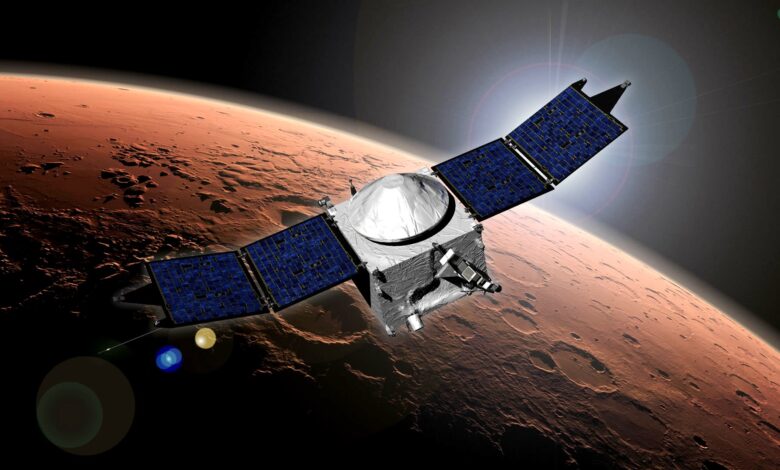
The scientific community is alarmed: one of NASA’s key spacecraft studying Mars has suddenly stopped making contact. Since December 4, 2025, the MAVEN Mars probe has shown no signs of life despite numerous attempts to reestablish communication. The last signal, received on December 6, only raised more questions — experts noted that the probe was not behaving as expected.
Data analysis revealed that MAVEN began spinning around its axis, something not intended in its flight plan. Additionally, the signal frequency suggests a possible change in its orbital trajectory. This could indicate the probe has encountered technical problems affecting its orientation and stability.
The MAVEN Mission
Launched in November 2013, MAVEN (Mars Atmosphere and Volatile Evolution) arrived at Mars ten months later. Its primary task is to study the atmosphere of the Red Planet and the processes involved in its loss. Thanks to MAVEN, scientists have obtained valuable insights into how and when Mars lost its dense atmosphere, which once allowed liquid water to exist on the surface billions of years ago.
After completing its main mission, the spacecraft continued to operate, providing new data on Martian winds, dust storms, and auroras. In addition to scientific research, MAVEN also serves an important role as a relay, enabling communication between Earth and the Curiosity and Perseverance rovers.
Trouble in Orbit
The MAVEN malfunction came as a surprise to NASA specialists. The spacecraft not only stopped responding to commands, but also appears to have begun spinning, which could result in loss of orientation and further complications. Changes in its orbit are also a concern: if MAVEN strays from its calculated trajectory, efforts to restore control and communication could become more difficult.
Despite these challenges, other orbital spacecraft continue to carry out their missions. Mars Reconnaissance Orbiter, Mars Odyssey, as well as the European Mars Express and ExoMars Trace Gas Orbiter, remain operational and support scientific missions on the Martian surface.
NASA’s response
NASA has already taken steps to minimize the impact of losing MAVEN. In the coming two weeks, additional flybys by other orbiters are planned to ensure continuous data transmission from the Mars rovers. The Curiosity and Perseverance teams have adjusted their plans to keep research on track without delays.
As experts analyze the situation and search for ways to bring MAVEN back online, the scientific community is following developments closely. Losing such an important tool could slow the study of Mars’ atmosphere and affect communication with active instruments on its surface.
The future of the mission
The future of MAVEN remains uncertain. If communication cannot be restored, the mission may be considered complete. However, experience shows that NASA engineers are often able to find creative solutions even in the most challenging situations. For now, all eyes are on the ongoing efforts to revive the spacecraft and determine the cause of its malfunction.
In case you didn’t know, MAVEN is one of NASA’s key projects for studying the Martian atmosphere. The spacecraft was launched in 2013 and since then has provided scientists with a wealth of unique data about the Red Planet. In addition to its scientific objectives, MAVEN plays a crucial role in maintaining communications between Earth and the Mars rovers. Its mission has been a major milestone in understanding the evolution of Mars’ atmosphere and the search for evidence of water on the planet.