Rare earth elements (REEs) play a crucial role in modern industry, electronics, and energy. However, their deposits are distributed extremely unevenly around the world. According to recent estimates, nearly half of all known reserves of these strategic resources are located in China. The country remains the outright leader, significantly impacting global supply chains and the balance of power in the world market.
Brazil holds the second position, with significant deposits, many of which are not yet fully developed. While developed economies like the United States are forced to rely on imports, countries with large reserves are shaping their own strategies for development and export.
China and Brazil: The Dominant Players
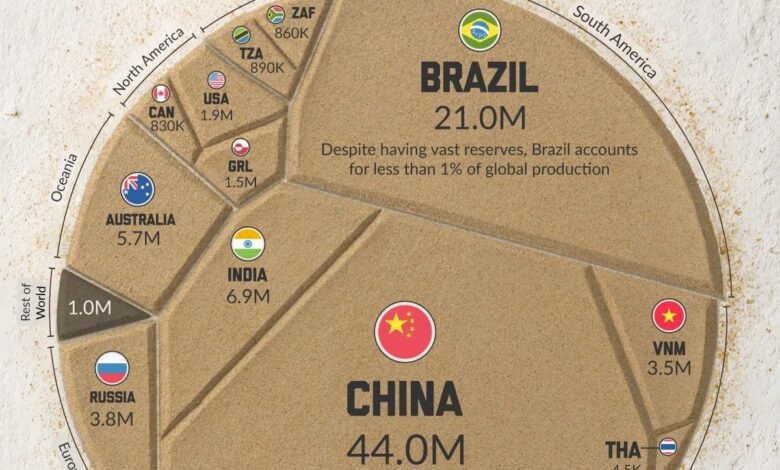
The People’s Republic of China holds about 44 million tons of rare earth metals, accounting for roughly 48% of the global total. Brazil, with 21 million tons, controls another 23% of world reserves. Together, these two countries set the pace of the global market, dictating the terms and prices for raw materials essential for producing electronics, electric vehicles, and alternative energy.
At the same time, India, Australia, Russia, and Vietnam are also among the leaders in reserves, although their share is significantly smaller. India holds 6.9 million tons, Australia 5.7 million, Russia 3.8 million, and Vietnam 3.5 million tons. These countries are gradually increasing production as they aim to strengthen their positions in the global market.
The Role of the US and Import Dependence
The United States, despite being one of the world’s leading economies, has only 1.9 million tons of rare earth metals, accounting for just 2% of global reserves. This situation forces the US to actively seek ways to reduce its dependence on foreign suppliers, especially China. In recent years, the American government has invested in developing its own mining industry, accelerated the issuance of licenses, and expanded cooperation with allies to diversify supply sources.
However, even with domestic deposits, the US faces technological and environmental constraints that hinder rapid production growth. This creates additional risks for the country’s national security and technological sovereignty.
Global Consequences and Prospects
The concentration of key rare earth metal reserves in the hands of a few countries is creating new challenges for the global economy. Nations lacking significant resources are forced to seek alternative sources, invest in processing, and develop recycling technologies. Meanwhile, industry leaders gain additional leverage on the international stage.
In the coming years, competition for access to strategic resources is expected to intensify. This could lead to the emergence of new alliances, changes in logistics routes, and stricter controls over the export of rare earth metals. Environmental and sustainability issues are also moving to the forefront, as mining and processing REMs pose serious ecological risks.
In case you didn’t know: What is Visual Capitalist
Visual Capitalist is a renowned international media project specializing in creating infographics and visualizing complex economic, financial, and technological data. Founded in Canada in 2011, the project quickly gained popularity thanks to its clear and informative content, making complex topics accessible to a wide audience. The Visual Capitalist team collaborates with leading experts, analysts, and research centers worldwide to provide up-to-date and reliable information. Their infographics are regularly used for educational purposes and are often cited by major international media outlets. The project continues to grow, expanding its topics and introducing new data presentation formats. Visual Capitalist places special emphasis on issues of sustainable development, innovation, and global economic trends. Thanks to the high quality of its visualizations, the project’s materials are in demand among professionals, students, and anyone interested in current trends. In 2025, Visual Capitalist remains one of the leaders in visual analytics, offering fresh perspectives on key global processes.