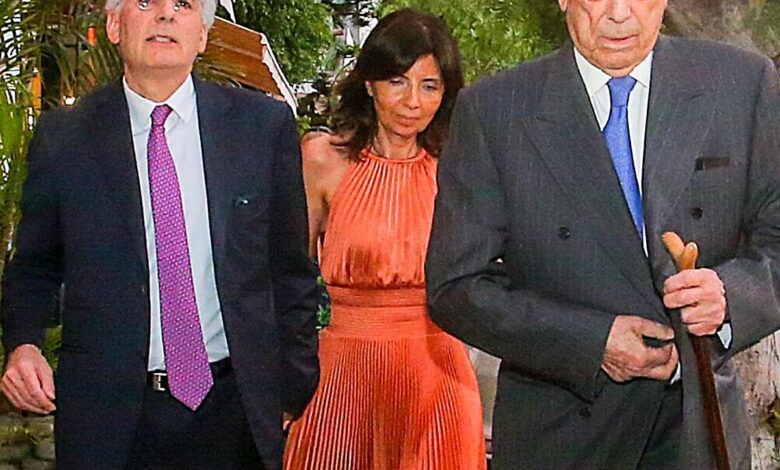
Seven months after the death of Mario Vargas Llosa at the age of 89, his eldest son Álvaro has initiated the official process to inherit the marquisate. This noble title was granted to his father by King Juan Carlos I in 2011 for his “outstanding and internationally recognized contributions to literature and the Spanish language.” Following the publication of the corresponding notice in the Official State Gazette (BOE), a thirty-day period has begun during which other potential heirs may assert their claims.
The writer himself responded to receiving the title with humor. He joked that “cholos [people of mixed heritage] have reached the Spanish aristocracy,” and added that despite the title, he would always remain “a commoner.” Nevertheless, he described the king’s gesture as “very touching” and admitted it came as a “tremendous surprise,” noting that he “never imagined he would be made a marquis.”
If there are no legal obstacles, Álvaro Vargas Llosa will soon become the second Marquis de Vargas Llosa. This will take place shortly after he honored his father’s memory at the Biennial in Cáceres, which was organized in the writer’s honor. “He won’t be a ghost trying to scare anyone, but will listen carefully to the lectures and presentations, learn from everyone, and, above all, eagerly ask in the hallways who will win, who will receive the prize,” Álvaro commented at the time.
However, the media’s attention to essayist Álvaro Vargas Llosa—also known for his criticism of Isabel Preysler’s memoirs—is not solely due to his impending aristocratic status. Several months ago, he revealed that his romantic relationship with Lebanese translator Nada Shedeed had come to an end. According to him, it happened at the worst possible time and in the most difficult way.
“While you were suffering, dying, and my mourning was just beginning, my partner—whom you knew—couldn’t come up with a better idea than to return to her country for good,” Álvaro wrote in a poignant letter, “Eulogy to My Father,” published by El País. In his piece, he also shared that the family divided the writer’s ashes between Europe and Lima, but it was his account of his beloved leaving him “without a farewell or any real explanation” during such a critical period that drew the most attention.
Álvaro and Nada met in 2006 during a family trip to Beirut, where she was studying Spanish at the Instituto Cervantes. Fourteen years later, a new meeting in Paris turned their friendship into a romance, which became public in 2021. Although the Lebanese woman did not comment on the reasons for the breakup, after the death of Mario Vargas Llosa she posted touching words of farewell on her social networks: “Though you are gone, you have left behind countless memories of conversations, journeys, and above all, humor. Rest in peace, dear Mario, you will be missed.”
Before his four-year romance with Nada Shedeed, Álvaro Vargas Llosa was married for two decades to Susana Abad, with whom he had three children: Julio, Leandro, and Aitana. Their unexpected separation occurred in July 2021, just a month before the essayist announced his new relationship. It was Susana Abad who revealed on her Twitter profile that she was ‘in the process of getting a divorce.’ Responding to surprised followers, the nutritionist said about Álvaro: ‘He is the father of my children, I love him very much,’ making it clear that their split was amicable. However, after news broke about her ex-husband’s breakup with the Lebanese woman, several of her social media posts led many to believe she was throwing verbal darts at the son of the Nobel laureate. ‘The world is round and it goes around many times,’ read one of the messages. She later added: ‘Two words. Ephemeral: fleeting, short-lived. And foolish: silly, vain, lacking sense. For the wise, a hint is enough.’
As a side note, Jorge Mario Pedro Vargas Llosa is a Peruvian and Spanish novelist, playwright, essayist, and politician. He was awarded the 2010 Nobel Prize in Literature ‘for his cartography of structures of power and his vivid images of resistance, revolt, and defeat of the individual.’ Vargas Llosa obtained Spanish citizenship in 1993 and has been actively involved in the social and political life of Spain, remaining one of the key figures in Spanish-language literature of the 20th and 21st centuries.