The question of prison populations in different countries has long sparked debate and discussion. New data reveal a stark disparity across nations on this issue. Some countries face overcrowded prisons, while in others, facilities remain nearly empty. These dramatic differences are rooted in legal frameworks, crime rates, and political decisions.
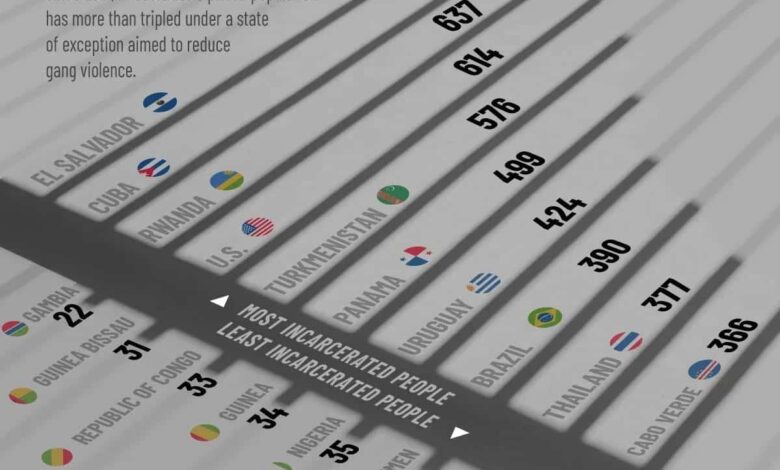
El Salvador currently ranks first in the world for the number of inmates per capita. Authorities have imposed a state of emergency, allowing them to detain suspected individuals en masse without providing basic legal protections. As a result, tens of thousands of people are now behind bars, and the murder rate has dropped nearly fivefold over the past three years. However, human rights groups note that many arrests were arbitrary and prison conditions are extremely harsh.
Cuba, known for its hardline stance against dissent, has also emerged as a global leader in prison populations. Here, not only criminal offenders but also political opponents end up behind bars. There are nearly 800 inmates per 100,000 residents— the second highest rate in the world.
Contrasts in Africa
While prisons in some Latin American and Caribbean countries are overcrowded, the situation on the African continent is different. Gambia boasts one of the lowest incarceration rates: just 22 people per 100,000 inhabitants. This trend is typical for most countries in the region. Seven out of the ten countries with the fewest prisoners are in Africa.
However, low numbers do not always indicate prosperity. Many African prisons suffer from chronic underfunding, staff shortages, and poor conditions. Nevertheless, mass arrests are rare, and criminal prosecution is applied less frequently than in other parts of the world.
Japan and developed countries
Japan is the only developed economy to make the list of countries with the lowest incarceration rates. Here, fewer than 40 people per 100,000 are behind bars. This result is attributed not only to effective law enforcement, but also to low levels of violent crime. The country has one of the lowest homicide rates in the world—just 0.23 cases per 100,000 people.
By comparison, in the United States, the rate exceeds 600 inmates per 100,000 residents. The U.S. ranks fourth worldwide, behind only El Salvador, Cuba, and Rwanda. The American justice system is known for its harshness and widespread use of lengthy prison terms, even for minor offenses.
Reasons for Differences
Such significant disparities between countries are explained by a range of factors. Some governments favor tough measures to combat crime, while others opt for alternative forms of punishment. The political climate, levels of corruption, economic development, and law enforcement traditions—all these influence how many people end up behind bars.
In some countries, mass arrests are used as a tool of political pressure. In others, the prison system is overloaded due to high crime rates or flawed legislation. There are also states where the low number of inmates is linked to lenient judicial practices or a lack of resources to house large numbers of convicts.
Global Trends
Worldwide statistics show that prison overcrowding remains a pressing issue in many countries. At the same time, there is growing interest in criminal justice reform and in finding alternative means of punishment. Some nations are already implementing programs aimed at reducing the prison population, focusing on rehabilitation and social reintegration.
Nevertheless, in several regions the situation remains tense. Mass arrests, harsh laws, and political repression continue to drive up incarceration rates. The question of which approach is most effective remains open and calls for further discussion at the international level.
In case you didn’t know, Prison Policy Initiative is a nonprofit organization specializing in the analysis and monitoring of prison systems worldwide. Its experts regularly publish research on prison conditions, inmate populations, and the effectiveness of criminal justice policies in different countries. Thanks to their work, the public gets access to objective information about the situation in correctional facilities and can compare approaches to justice in various nations.