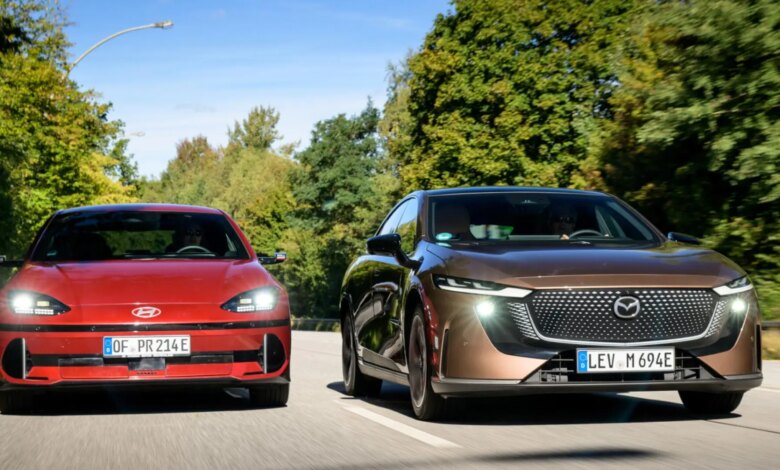
The shift to electric power in the sedan segment no longer looks like an unconditional victory for technology. Owners of the Hyundai Ioniq 6 and Mazda6e face a reality where every minute spent charging and every kilometer traveled takes on special significance. It’s no longer just about who accelerates faster or drives more quietly—now, the finer details come to the forefront, capable of turning a trip into a pleasure or a string of annoying compromises.
When comparing these two models, it becomes clear: outward elegance and the manufacturers’ promises are just the tip of the iceberg. Behind the stylish lines are technical solutions that can either make life easier or add a headache. And if anyone still believes that electric cars are only about ecology and savings, it’s time to look at the numbers and facts without rose-colored glasses.
Technical Paradoxes
The Hyundai Ioniq 6 and Mazda6e appear to play in the same league: both are low, dynamic sedans seemingly designed for long journeys. But under the hood, they take different approaches to what a modern electric vehicle should be. The Mazda6e boasts a 258-horsepower motor, while the Hyundai offers 229, but the power difference isn’t as critical as it might seem at first glance. Both cars deliver torque to the rear wheels through a single-speed transmission, ensuring smooth operation and predictable handling.
However, things heat up when it comes to batteries. The Mazda6e has 68.8 kWh, while the Hyundai has 77.4 kWh. But capacity isn’t everything: thanks to its 800-volt architecture, the Ioniq 6 can charge at up to 220 kW, letting you go from 10 to 80% in just 18 minutes. The Mazda6e, with its 400-volt system and 165 kW, takes 24 minutes for the same process. The difference might not seem critical, but in the rush of city life or on long trips, every minute spent charging can dampen your mood.
Range is another sticking point. The Hyundai confidently covers almost 500 kilometers on a single charge, while the Mazda has to stop noticeably sooner. For drivers used to unrestricted movement, this turns into a daily calculation: will the battery last until the next station, or will you need to hunt for an outlet at the nearest supermarket?
Performance and comfort
On the road, the Hyundai Ioniq 6 shows unexpected agility: it accelerates faster, handles more confidently, and feels light despite its considerable size. The steering and suspension work in tandem, giving the driver a true sense of control. Admittedly, the suspension can feel a bit stiff over small bumps, but overall, the car’s handling inspires confidence.
The Mazda6e, on the other hand, focuses on softness and comfort. The suspension absorbs most road imperfections, but there’s a trade-off: after hitting large potholes, the rear of the car can sway noticeably, and the overly sharp steering response sometimes leads to instability at high speeds. Additionally, the Mazda6e’s retractable spoiler not only worsens the view through the already narrow rear window but also creates extra hassle when parking.
However, the Mazda6e’s brakes work flawlessly: from 100 km/h, the car stops two meters sooner than the Hyundai. In city conditions and heavy traffic, this can be a decisive advantage. The Ioniq 6, despite overall stability, shows quirks: under hard acceleration on the highway, the car drifts slightly to the left, and under braking, it adjusts to the right. Not critical, but for perfectionists, it’s something to consider.
Interior and ergonomics
Inside, both cars aim to impress with technology, but it doesn’t always work in their favor. The Hyundai Ioniq 6 comes with cameras instead of mirrors, and if anyone thinks that’s progress, let them try changing lanes in dense traffic while looking at tiny screens with distorted perspective. Plus, the sheer number of displays in the cabin is starting to resemble a spacecraft control center—not everyone is ready for that kind of information overload.
Mazda6e, on the other hand, minimizes the number of buttons, which takes some getting used to, but the interior looks sleek and modern. The front seats in the Mazda6e are comfortable and supportive, while the Hyundai offers a pleasant, though less cozy, seating experience. In the rear, the Ioniq 6 has more space, while the Mazda6e feels a bit tighter, but the Japanese model boasts a 466-liter trunk plus a spacious 72-liter frunk. The Hyundai’s trunk is just 401 liters, with access restricted by a small lid—not the best option for family trips.
Finances put everything into perspective: a fully equipped Hyundai Ioniq 6 will cost as much as buying not only a Mazda6e, but also a couple of decent vacations in the Canary Islands. The top-tier Mazda6e is almost twenty thousand euros cheaper, and that’s not just a difference—it’s a decisive factor for those who are careful with their budget.
Head-to-head comparison
The Hyundai Ioniq 6 is technologically advanced, fast, and offers impressive range, but its price and some ergonomic choices raise concerns even among the brand’s most loyal fans. The Mazda6e isn’t perfect, but its combination of design, comfort, and cost makes it an appealing choice for pragmatists who aren’t chasing trends but prefer a balance between capabilities and reality.
In the end, both cars score the same number of points according to the experts, but Mazda6e takes the lead in terms of value for money. Still, for anyone who thinks electric cars are only about saving money and the planet, it’s worth living with one for at least a month. You’ll quickly learn that true savings aren’t just about kilowatts, but about peace of mind, too.
Hyundai is a South Korean automotive giant that has recently focused on electric vehicles and is actively introducing innovative solutions to the mass market. The Ioniq 6 model has become a symbol of the brand’s new approach to design and technology, though it hasn’t avoided controversial decisions that have sparked lively debates among car enthusiasts. The Mazda6e, meanwhile, carries on the traditions of the Japanese school: emphasizing comfort, simplicity, and practicality—qualities especially valued by drivers who prefer a calm and measured driving experience. Both brands are aiming for leadership in the electric vehicle market, but their approaches differ, creating a striking contrast between their models.