Rovers are more than just wheeled machines—they are true pioneers, unveiling uncharted corners of other worlds for humanity. Thanks to these vehicles, we’ve gained unique insights into the Moon and Mars, along with many discoveries that have transformed our understanding of the structure and evolution of planets. This article highlights five of the most significant rovers that have made a lasting mark on the history of space exploration.
Each of these rovers became a symbol of its era and technological progress. Their missions involved highly complex engineering solutions, and the results of their work are still being analyzed by scientists worldwide. From the Soviet ‘Lunokhod-1’ to India’s ‘Pragyan,’ they have all proven that automated craft can tackle the most challenging tasks far from Earth.
First Steps on the Moon: The Soviet ‘Lunokhod-1’
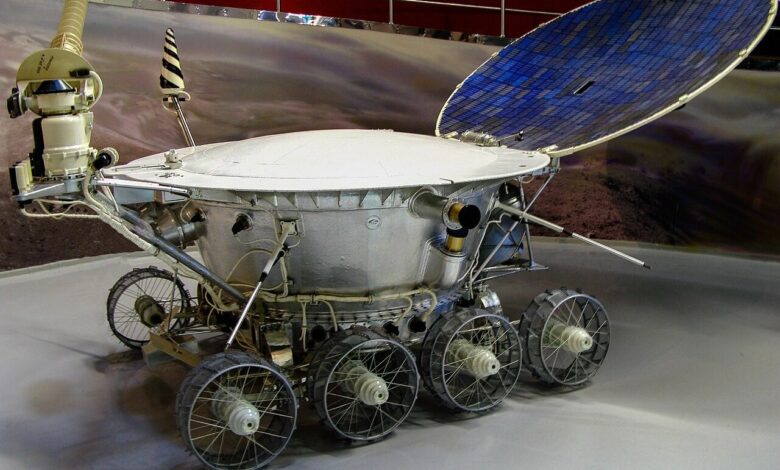
In November 1970, ‘Lunokhod-1’ touched down on the Moon—a historic first as a rover successfully operated on another celestial body. Its launch was a true breakthrough for Soviet space exploration. This eight-wheeled vehicle, weighing 756 kilograms, was remotely controlled from Earth and equipped with two television cameras as well as four panoramic imaging instruments.
During its 11 months of operation, Lunokhod-1 covered 10.5 kilometers, explored an area of about 80,000 square meters, and conducted hundreds of experiments with lunar soil. More than 20,000 images were transmitted to Earth, including 200 high-resolution panoramas. Thanks to this data, scientists gained a new perspective on the Moon’s geology and refined its estimated age.
Martian debut: Sojourner and the dawn of a new era
In 1997, Sojourner became the first rover in history to successfully traverse the surface of the Red Planet. This compact machine weighed just 10.6 kilograms, yet was equipped with everything needed for scientific research. Sojourner was part of the Mars Pathfinder mission, launched by NASA in December 1996.
Initially, the rover was expected to operate for no more than a week, yet it lasted 83 Martian days—12 times longer than engineers had anticipated. During this period, Sojourner traveled about 100 meters while staying within communication range of the lander, gathering valuable information about the composition of Martian rocks. Its success proved that small, lightweight vehicles could perform efficiently in Mars’ harsh conditions.
A technological breakthrough: Perseverance and the Ingenuity helicopter
In February 2021, Perseverance—the most advanced NASA rover to date—landed on Mars. Its standout feature is a 2.1-meter robotic arm equipped with high-precision scientific instruments. Perseverance was sent to Jezero Crater, where scientists believe an ancient lake once existed.
Alongside the rover, the mini-helicopter Ingenuity was delivered to Mars, completing 72 flights instead of the five originally planned. Perseverance is not only studying the planet’s geology but also collecting soil samples for future return to Earth. Its mission opened a new chapter in Mars exploration and demonstrated the capabilities of autonomous robots in extreme environments.
Return to the Moon: China’s Yutu and India’s Pragyan
In December 2013, China sent the Yutu rover to the Moon as part of the Chang’e-3 mission. This was the first successful lunar rover in nearly 40 years. While it was initially expected to operate for three months, it functioned for 973 days despite losing mobility. Yutu continued to collect scientific data, and its radar provided unique information about the structure of the Moon’s subsurface.
In August 2023, India joined the lunar exploration effort. The Pragyan rover, part of the Chandrayaan-3 mission, landed near the lunar south pole, where water ice deposits are believed to exist. In 12 days of operation, the rover traveled 101.3 meters and analyzed the surface using an X-ray spectrometer. Despite its short mission, Pragyan managed to transmit important scientific data.
The contribution of rovers to science and the future of exploration
Each of these vehicles not only pushed the boundaries of our knowledge but also became a symbol of their nation’s technological progress. Thanks to their work, scientists have gained new insights into the composition and structure of lunar and Martian soil, as well as the potential for water to exist on other planets.
Rovers continue to inspire engineers and researchers to design new, even more advanced machines. Their achievements prove that robotic spacecraft can tackle challenges once thought impossible. In the coming years, humanity plans to launch new missions to the Moon, Mars, and even the moons of Jupiter and Saturn.
If you didn’t know, NASA (National Aeronautics and Space Administration) is the leading US space agency, founded in 1958. NASA experts developed and launched such famous Mars rovers as Sojourner, Curiosity, and Perseverance. The agency actively collaborates with international partners and continues to develop new missions to explore the Solar System and deep space.