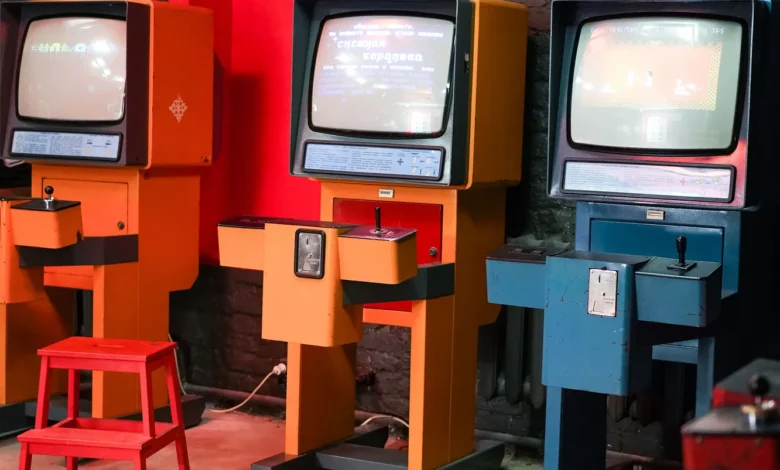
In the early 1970s, an exhibition took place in Moscow that marked the starting point for the emergence of Soviet arcade machines. At “Attraction-71,” dozens of new models from the US, Japan, and Europe were showcased for the first time. The event generated huge public interest: thousands of Muscovites and visitors to the capital lined up to try out these never-before-seen amusements. After the exhibition closed, some of the machines remained in the country, and Soviet authorities decided to launch their own production of such devices.
The first domestically produced machines were almost exact copies of their Western counterparts. Leading design institutes and enterprises linked to the defense industry worked on their development. Components originally meant for military electronics were used, making the machines durable but quite heavy and expensive to manufacture. For example, the famous “Morskoy Boy” was based on the American “Sea Raider” from 1969, but acquired its own unique features.
Engineering solutions
Soviet engineers quickly mastered the technology of dismantling and analyzing foreign arcade machines. Military factories established entire labs where specialists studied arcade internals and developed Russian versions. As a result, not only copies were produced, but also original designs with no foreign analogues. Companies from the radio, instrument-making, aviation, and shipbuilding industries took part in manufacturing.
A key feature of Soviet arcade machines was their ideological focus. Gambling was banned, so the machines did not dispense cash prizes. The most a player could hope for was an extra free game or a small souvenir. The Ministry of Culture closely monitored to ensure that the machines promoted the development of useful skills such as reaction speed, attention, logic, and memory. For example, the ‘Viktorina’ machine tested knowledge of traffic laws, while ‘Pamyat’ trained memory by challenging players to recall sequences.
Organization and oversight
The distribution and maintenance of arcade machines was overseen by the All-Union Association ‘Soyuzattraktsion’ and the Central Research Laboratory of Attractions (TSNILAT). These organizations not only maintained the technical condition of the machines but also adapted Western arcade games to Soviet realities. Research was conducted to study how arcade machines influenced the upbringing of young people and the development of useful habits.
In the 1980s, arcade machine production became an important part of the development of computer technology in the USSR. For many children and teenagers, arcade machines were their first introduction to the principles of human-machine interaction. They served as a kind of bridge between the analog era and the digital society of the future.
Variety of models
Soviet arcade machines were divided into two main categories: electromechanical and electronic. The first operated using complex mechanisms, while the latter used television picture tubes. The selection included sports simulators, shooting and racing games, military simulators, pinball machines, claw machines, and even kiddie rides for the youngest visitors.
The Museum of Soviet Arcade Machines in Moscow houses a unique collection. Here you can find both popular and rare examples: “Astropilot”, “Magistral”, “Sniper”, “Basketball”, “Penalty”, “Repka”, “Gorodki”, “Konek-Gorbunok”, and many others. Some were based on Russian fairy tales and folk games, which gave them a distinctive flair and made them recognizable to Soviet children.
Cultural impact
Arcade machines became an integral part of urban life. They were installed in parks, community centers, movie theaters, and even train stations. For many Soviet children and teenagers, a trip to the arcade was a real event. The machines not only provided entertainment but also shaped new habits, promoting the development of technical thinking and interest in electronics.
Soviet arcade machines had a unique aesthetic: bright panels, recognizable illustrations, and distinctive sounds. They reflected the spirit of the times, blending engineering solutions with elements of folk culture and state ideology. Some models, such as “Morskoy Boy” (Sea Battle) or “Pamyat” (Memory), became true symbols of the era.
In case you didn’t know, the Museum of Soviet Arcade Machines in Moscow is not only an exhibition space but also an interactive venue where visitors can try their hand at authentic arcade games from the past. The museum’s collection features dozens of restored machines, many of which were saved from disposal and carefully refurbished. The institution is actively involved in educational initiatives, offering guided tours and themed events, and collaborates with researchers of Soviet technology and cultural history.