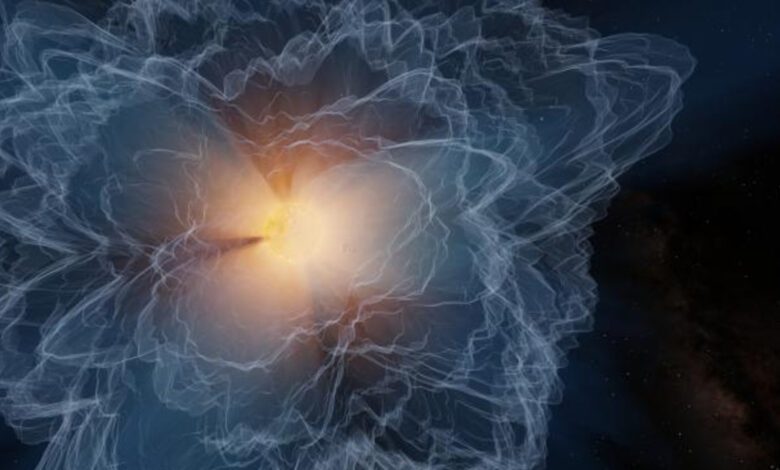
A team of researchers has presented the first-ever detailed maps of the outer boundary of the Sun’s atmosphere—the region where solar material finally breaks free from the Sun’s magnetic field and rushes into interplanetary space. These maps, created using unique data from the Parker Solar Probe and other spacecraft, have revealed how this boundary shifts depending on solar activity. It turns out that during the peak of the solar cycle, this boundary not only expands but also becomes noticeably more irregular and ‘spiky’.
Until recently, scientists could only speculate about the exact location of this invisible line separating the Sun from space. Now, thanks to direct measurements, researchers can not only observe its changes but also construct accurate models of solar wind behavior. This discovery promises to greatly improve space weather forecasts, which is particularly important for protecting satellites, power systems, and astronauts.
The dynamics of the solar boundary
The main focus of the study was the so-called Alfvén surface — a boundary beyond which the solar wind moves faster than magnetic waves can carry it back toward the Sun. This is precisely where particles finally leave the star and speed off into interplanetary space. Over the course of the 11-year solar cycle, this surface expands and contracts, and its shape becomes increasingly complex as solar activity approaches its peak.
Previously, scientists could only infer the behavior of this boundary indirectly, using data from distant probes. Now, thanks to Parker Solar Probe’s record-breaking close flybys, direct measurements have been obtained right near the Alfvén surface. This has not only confirmed theoretical predictions, but, for the first time, revealed just how dramatically the structure of this region changes depending on the phase of the solar cycle.
Technologies and methods
To build new maps, researchers combined data from several missions at once. Parker Solar Probe, performing risky maneuvers near the Sun, transmitted information on particle flows and magnetic fields. At the same time, the European Space Agency’s Solar Orbiter and NASA’s Wind probe, both located about 1.5 million kilometers from Earth, recorded solar wind parameters at a greater distance.
A key role was played by the SWEAP (Solar Wind Electrons Alphas and Protons) instrument installed on board Parker. It enabled direct measurement of the composition and speed of particles in the area beneath the Alfvén surface. By comparing these data with observations from other spacecraft, scientists were able to pinpoint with great accuracy where the Sun’s magnetic influence ends and the solar wind begins its free movement.
Impact on Earth and Science
Understanding how and where the solar wind leaves the Sun is crucial for modern science and technology. These processes determine the strength of geomagnetic storms that can disrupt satellites, radio communications, and even electrical grids on Earth. Additionally, the new maps will help shed light on the so-called coronal heating mystery—why the temperature of the solar corona, the Sun’s outermost atmospheric layer, is hundreds of times higher than that of the star’s surface.
In the coming years, as the Sun enters a new minimum activity phase, the Parker Solar Probe will continue its missions, allowing scientists to observe changes in the structure of the atmospheric boundary throughout an entire solar cycle. This will not only help refine current models but may also reveal new physical phenomena related to plasma and magnetic field behavior.
The Future of Research
The authors of the study emphasize that despite significant progress, many questions about the nature of the solar corona and the mechanisms behind solar wind acceleration remain unanswered. The new data have already allowed scientists to revise some ideas about the dynamics of the star’s atmosphere, but many mysteries still lie ahead.
Going forward, researchers plan to use these maps to study the atmospheres of other stars and to improve early warning systems for space weather. This is particularly relevant in an era when humanity is increasingly venturing into near-Earth space and preparing for long-distance crewed missions.
If you weren’t aware, Parker Solar Probe is a unique NASA spacecraft launched in 2018 to study the Sun from an unprecedentedly close distance. The probe performs a series of flybys, passing through the hottest and most dangerous regions of the star’s atmosphere. Thanks to this project, scientists have, for the first time, been able to directly study the processes taking place in the Sun’s corona and have made significant advances in understanding solar wind and space weather.