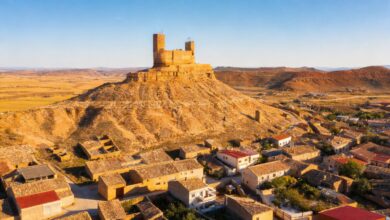
In the very heart of Castilla y León, where the land is painted in shades of ochre and terracotta and time flows slowly like the Duero River, lies a town undeservedly overlooked by mass tourism. This is Almazán, just over thirty kilometers from the provincial capital, Soria. The town doesn’t shout about its virtues—it whispers its stories to those willing to listen. Here, the past hasn’t frozen in stone; it continues to live in the winding streets, in the shadows of arcades, and in the memory of the great playwright who found his final refuge here.
A stone heart on the banks of the Duero
The city’s heartbeat resounds in its central square, the Plaza Mayor. More than just an open space, it’s a true architectural theater where two monumental buildings play the leading roles. On one side rises the Palacio de los Hurtado de Mendoza, its Renaissance facades exuding both austerity and grandeur, while its graceful Gothic-Isabelline gallery adds an air of lightness and sophistication. Opposite stands the Church of San Miguel, a formidable Romanesque temple from the 12th century. From the outside, it appears an unassailable fortress of faith, yet inside it hides a true marvel of engineering and artistic vision. Its dome, crafted in the Mudéjar tradition, is a complex ribbed construction that intersects to form an eight-pointed star at its zenith—a symbol uniting Christian and Muslim cultures. This dialogue between palace and church, secular power and spiritual authority, creates a unique atmosphere on the square, one that invites you to linger for hours.
The entire historic center is embraced by fortress walls dating back to the 12th and 13th centuries. Walking along them is a journey through time, to when Almazán was a key frontier stronghold. From above, you’ll enjoy breathtaking views of the winding Duero and the endless Castilian fields. To enter, you must pass through one of the three surviving gates—Herreros (Blacksmiths’), de la Villa (Town), or del Mercado (Market). Each has its own character. The defensive line is interrupted only by a cylindrical bastion known as the Rollo de las Monjas. The recently restored San Miguel gate has become a kind of observation deck—a modern balcony overlooking eternity.
In the footsteps of the great playwright
The spiritual life of the town is centered not only around the church of San Miguel. Nearby stands the unusual chapel of Jesús Nazareno, built on the site of the old parish church of Santiago. Its octagonal shape and austere neoclassical portal make it stand out among the surrounding buildings. And if you look higher up, on the hill, you can see the church of Nuestra Señora del Campanario, which has preserved its three original Romanesque apses. But perhaps the most iconic place for Spanish culture in Almazán is the modest monastery of Nuestra Señora de la Merced. Here lie the remains of Gabriel Téllez, better known to the world by the pen name Tirso de Molina. One of the pillars of Spain’s Golden Age and the creator of Don Juan, he spent his final days within these walls. To visit this place is to feel a direct connection to an entire era of world literature.
The vibrant soul of rural Castile
To take a break from the historical sights, just cross the river and find yourself in the La Arboleda Park. This oasis of peace and cool shade stretches over fourteen hectares. A walk among poplar trees along modern wooden walkways offers new, unexpected perspectives of the old town reflected in the water. This architectural ensemble, embraced by ancient walls, is the perfect place for quiet reflection or a leisurely picnic. But the tranquility is deceiving. Twice a year, Almazán bursts with color and emotion. In May, the San Pascual Bailón festival takes place, recognized as a regional event of tourist interest. The streets fill with dancers performing 18th-century dances, led by the central figure—the Sarrón. This character, dressed in a whimsical shepherd’s costume, brings the true spirit of carnival to the town. September is dedicated to deeper emotions. During the Descent of Jesus the Nazarene, the statue of the saint is ceremoniously carried from the Campanario church to his chapel. The procession crosses the main square to the sound of firecrackers and a shower of flowers—a moving spectacle that stirs the soul.
Between strolls and holidays, be sure to discover the local gastronomic traditions. The pastries “yemas” (egg yolk sweets) and “paciencias” (patience biscuits) will leave you with a sweet memory of your trip. Then you can return to Plaza Mayor, sit at one of its cafés, and simply watch the sun glide across the ancient stones, continuing the eternal dialogue between the palace, the church, and the fortress walls.