London’s architectural landscape has transformed beyond recognition in recent decades. The city, for centuries known for its Gothic spires and Victorian facades, now showcases a bold mix of concrete, glass, and steel. Five contemporary buildings have not only adorned the capital, but have become landmarks of a new era where tradition meets innovation and the past debates the future.
The Lloyd’s Building, designed by Richard Rogers, posed a real challenge to the classical architecture of the City. Its technical communications are routed outside, giving the building a futuristic appearance. In 2011, it received the highest level of protection—a rarity for such a modern structure. Lloyd’s has not only changed perceptions of commercial architecture, but has also become a symbol of the openness to experimentation so valued in the British capital.
Concrete and energy
The Barbican Centre is more than just a residential complex—it’s an entire city within a city. Its massive concrete forms, created in the 1960s, remain controversial: some see them as ugly, others as ingenious. Today, the Barbican is experiencing a renaissance, buzzing with cultural activity and home to more than 4,000 residents. The complex is undergoing major renovations, and each new phase sparks lively debates among architects and city dwellers alike.
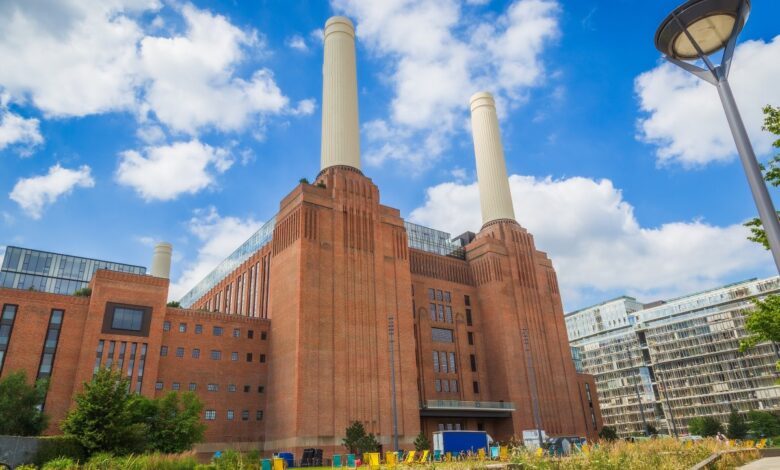
Battersea Power Station, once providing electricity to half of London, has now transformed into a trendy hotspot. Its four giant chimneys, familiar to every Londoner, are now part of a vast retail space with restaurants, shops, and even a hotel. The restoration took nearly ten years, but the results exceeded expectations: the industrial past has blended seamlessly into the modern urban landscape.
Ecology and Style
The Gherkin skyscraper, designed by Norman Foster, is a benchmark of environmentally conscious construction. Its aerodynamic shape not only adorns London’s skyline but also reduces wind loads on neighboring buildings. The building boasts a unique natural ventilation system that saves energy, making The Gherkin a symbol of the metropolis’s ‘green’ architecture. Often serving as a backdrop for photoshoots and lively discussions, its striking appearance leaves no one indifferent.
Coal Drops Yard is a vivid example of how historic industrial sites can be given new life. Architect Thomas Heatherwick transformed former coal warehouses into a fashionable district of boutiques, cafés, and restaurants. This area quickly attracted students, office workers, and tourists alike. The opening of Coal Drops Yard marked a new era for the King’s Cross neighborhood, which had been seen as rundown not long ago.
Tradition and Transformation
London has repeatedly proven its ability to surprise even the most discerning architecture enthusiasts. Each of the five buildings is not just a structure, but a reflection of the era in which it was created. Their appearance sparked heated debates, much like the time when Toledo saw arguments erupt over the recognition of a unique craft that transformed the city’s image. Similar stories can be found in other countries as well, for example, in Castilla-La Mancha, the fight to preserve traditions has led to new tourist discoveries. In London, architectural experiments have become part of the city’s identity, and the debates they generate only fuel interest in the British capital.
Each of these buildings is an integral piece of the city’s mosaic, where past and future intertwine into a single fabric. London continues to change, and perhaps tomorrow a new landmark will appear on its map, once again drawing global attention.
Edificio Lloyd’s is not just an office building, but a true engineering marvel that has become an emblem of London’s City. Its unusual design, with all communications moved to the exterior, allowed for the most efficient use of interior space. The building is often called an ‘inside-out skyscraper’, and it regularly appears on lists of the world’s most extraordinary constructions. Lloyd’s has become not only a symbol of innovation, but also an example of how modern technology can transform the traditional cityscape.