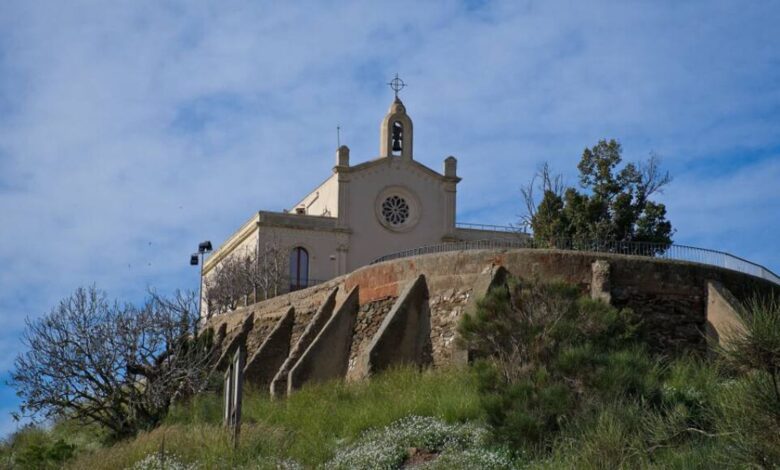
In Catalonia, where every stone preserves its history, there is a place that sends chills even to skeptics. Atop a hill rising above the Llobregat Valley stands a chapel, a symbol not only of architectural heritage but also of inexplicable phenomena. As darkness falls, the line between reality and myth vanishes here: whispers fill the air, and among the fog fleeting silhouettes appear, as if emerging from another era.
During the day, pilgrims and tourists come here to enjoy panoramic views stretching across Garraf, Montserrat, and even the distant Balearic Islands. But with sunset, the chapel turns into a magnet for thrill-seekers. Locals speak of glowing orbs hovering above the dome and figures in dark cloaks dissolving into the night. Everyone who dares to stay after sundown describes a strange sense of unease, as if unseen eyes are watching them.
An architectural mystery
The chapel was built at the end of the 19th century by architect Josep Estruch i Comella, who dedicated it to his parents’ memory. The building’s unusual style, combining local traditions with elements of neo-Caravan architecture, makes it stand out among other religious structures in the region. The location is no coincidence: the summit, formerly known as La Fita, divides three municipalities and has long been considered a special point on Catalonia’s map.
During the years of the Civil War, the chapel was destroyed but later rebuilt. Today, it houses a modern statue of San Ramón Nonato, the patron saint of newborns. Every August, on the last weekend of the month, believers gather here to light candles and bring offerings. However, as night falls, completely different visitors arrive: paranormal investigators, ghost hunters, and the simply curious. They claim to have recorded strange voices on audio, and some have even felt physical pressure, as if an invisible force were tightening around their chest.
Nighttime fears
When night descends, the chapel and its surroundings transform. The wind brings not only a refreshing coolness but also echoes of ancient chants. According to eyewitnesses, you can hear footsteps that don’t belong to any living soul, and sometimes the ringing of bells that don’t exist. Legends say that ghostly monks wander the paths, and shadows on the walls take on a life of their own. Some link these phenomena to the fire of 1936, while others connect them to ancient rituals supposedly held here long before the chapel was built.
Locals believe that the mountain holds more than just memories of tragic events. The energy emanating from this place is felt even by those who don’t believe in the mystical. It’s no wonder that the San Ramón chapel has become one of the most talked-about sites among mystery and puzzle enthusiasts.
Myths and reality
Interestingly, similar stories can be found in other parts of Spain. For example, in Navarra, there is a village where a medieval monastery and ancient houses are also shrouded in legends and mysteries. An article about how such places become magnets for travelers tells the story of a mysterious village in the mountains of Navarra, where time seems to have stopped and the atmosphere is filled with the spirit of the past.
In Catalonia, the chapel of Sant Ramon continues to attract not only believers but also those seeking encounters with the inexplicable. Every year, new researchers come here, trying to unravel the nature of these strange phenomena. Some believe the unique acoustics and landscape are responsible, while others are convinced that something otherworldly really dwells here.
A place of power
At 289 meters above sea level, there is a breathtaking view of the surroundings, but at night this landscape takes on an entirely different meaning. The wind roaming the slopes seems to carry voices from bygone eras. For some, it is just a beautiful legend; for others, it is a reality they have to face head on. In any case, the chapel of Sant Ramon stopped being merely an architectural monument long ago: it has become a symbol of humanity’s encounter with the unknown.
Josep Estruch i Comella, the architect who designed the San Ramón chapel, was not only a master of his craft but also a figure whose fate is closely intertwined with the region’s history. His works stood out for their bold combination of tradition and innovation, which allowed him to leave a significant mark on Catalan architecture. The chapel, built in memory of his parents, became not just a place of worship but also the center of a host of urban legends. Thanks to his vision, this site still sparks debate and admiration, continuing to inspire new generations of researchers and travelers.