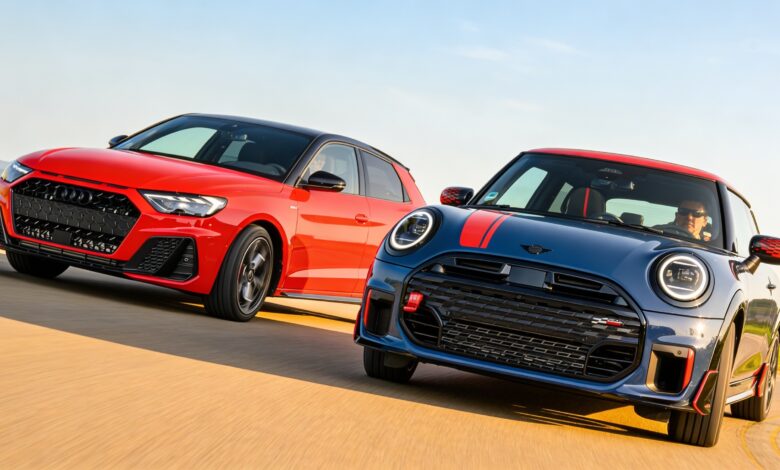
The compact sports hatchback segment in Spain is going through tough times: in recent years, models like the Hyundai i20 N, Ford Fiesta ST, and Renault Clio R.S. have left the market. Against this backdrop, the Mini John Cooper Works and Audi A1 40 TFSI are the ones keeping the bar high for driving excitement and premium status among city cars. Both vehicles are available on the Spanish market and target those seeking not just style, but real emotion behind the wheel.
Positioning and competitors
The Mini JCW and Audi A1 40 TFSI are essentially the last of their kind among compact petrol sports cars with a premium focus. In Spain, you can still find them at dealerships, although the range in this segment has noticeably narrowed. The Volkswagen Polo GTI, which could have been a rival, is absent from this comparison, further highlighting the uniqueness of the Mini and Audi duo. Both cars are aimed at buyers who value not only performance but also status and are prepared to pay a premium price for emotion and individuality.
Mini JCW: evolution without revolution
The Mini John Cooper Works in its latest version retains its recognizable style: a short hood, contrasting roof, signature stripes, and large round headlights. Externally, the model features new 18-inch wheels with Conti SportContact 7 tires, which are marketed in the configurator as “sporty,” although in reality, they are simply a grippier alternative to the standard eco-friendly tires. Inside, Mini has focused on digitalization: a fully digital instrument cluster, smartphone integration, and changing color themes depending on the driving mode. However, the sporty spirit in the cabin design has become less pronounced, and the logic of the on-screen information display raises questions even among experienced drivers.
Audi A1: maturity and tactile quality
The Audi A1 40 TFSI counters the Mini not only with a more restrained design, but also with a sense of maturity. Inside, there are high-quality materials, well-thought-out ergonomics, and classic instrument layout, which stands out against the digital experiments of its competitor. The two-liter TSI engine delivers 207 hp and 320 Nm, providing confident thrust and quick throttle response. However, the S tronic automatic transmission does not always keep up with its sporty ambitions: manual gear changes come with a delay, and the sixth and seventh gears are clearly geared towards fuel efficiency, not track performance.
Dynamics and driving experience
The Mini JCW is objectively faster: it accelerates from 0 to 100 km/h in 5.9 seconds, and up to 200 km/h in 22.9 seconds. The Audi lags behind by 0.4 and 1.6 seconds, respectively. The Mini offers a wider selection of drive modes, crisp gear shift responses, and a slightly higher top speed. However, it is the Audi A1 that feels more lively and ‘honest’ to drive: Mini’s engineers, in pursuit of digital perfection, have essentially isolated the driver from the mechanicals, diminishing the satisfaction from feedback.
Steering and track behavior
The Audi A1’s steering is not perfect—it is light and not very informative at larger steering angles, but it remains linear and gives you a sense of the front-axle grip limit. In the Mini JCW, the steering feels artificial: the effort constantly changes, ranging from excessive stiffness when parking to lightness at low speeds and suddenly heavy at high speeds. On the track, the Mini beats the Audi by about 1.3 seconds thanks to its more powerful engine and grippier tires, but its chassis tends to understeer more quickly, especially at the front axle, limiting the driver’s potential. The Audi, despite less sporty tires, handles predictably, easily, and even playfully within its limits.
Comfort and market context
In terms of comfort, the Mini absorbs bumps better, although it sacrifices some road feedback. The Audi A1 responds more stiffly to rough asphalt but keeps the driver more connected with the road. It’s important to note that both cars remain niche offerings for Spain: they are chosen by enthusiasts willing to pay for a unique balance between urban format and sporty character. Against the backdrop of the general trend towards electrification and the disappearance of petrol ‘hot hatches,’ such models are becoming increasingly rare. A similar trend can be seen in other segments, as demonstrated by the Peugeot 408, which is focusing on hybrids and electric vehicles.
The Mini John Cooper Works and Audi A1 40 TFSI are not just the last representatives of sporty city cars with petrol engines, but also a kind of challenge to the mass shift towards electrification. Their role in the Spanish market is a reminder that driving excitement and individuality are still in demand, albeit in a narrow niche.