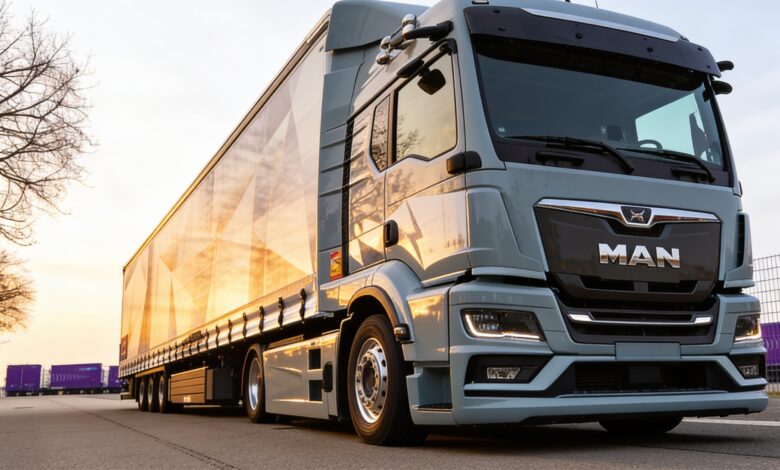
MAN Truck & Bus raises the bar once again for electric trucks, sending the eTGS Ultra on an almost thousand-kilometer journey from Paris to Berlin. This route isn’t just a showcase of the new technology’s capabilities, but an attempt to prove that electric propulsion is already able to compete with diesel on long-distance European routes. For the Spanish market, where the shift to eco-friendly transport is becoming increasingly relevant, such trials are an important signal: the technology is ready—the question now is the infrastructure.
Range test: 992 km across four countries
At the center of attention is the MAN eTGS Ultra, a battery-powered long-haul tractor with a 534 kWh battery, designed for hauling semi-trailers. On its nearly thousand-kilometer route, the truck had to cross France, Belgium, the Netherlands, and Germany, stopping at Milence charging stations—a joint venture of TRATON GROUP, Daimler Truck, and Volvo Group. According to MAN, the eTGS Ultra’s range on a single charge reaches up to 570 km, allowing for real commercial trips with a minimum number of stops.
During the test drive, MAN made stops at key points: Saint-Witz in France, Ghent in Belgium, Zwolle in the Netherlands, and several stations in Germany — Mogendorf, Kassel-Lohfelden, and Vockerode. Such a route allows the evaluation not only of the technical capabilities of the truck itself, but also of Europe’s readiness to support heavy electric vehicles over long distances.
Infrastructure — the main challenge
MAN emphasizes that modern electric trucks are already capable of operating in real-world conditions, and the main limitation is no longer the technology itself, but the network of fast charging stations. According to company representatives, a large-scale investment in infrastructure development across Europe is needed for a mass transition to electric vehicles. Despite the efforts of Milence and other players, the existing network still does not meet all the needs of commercial transport.
In Spain, where interest in electric trucks is growing, the issue of infrastructure is especially acute. Without a sufficient number of high-capacity charging points, even the most advanced models, such as the MAN eTGS Ultra, will not be able to realize their market potential. The manufacturer is actively investing not only in the vehicles themselves, but also in building an ecosystem: the MAN Charge&Go and MAN Transport Solutions services are designed to facilitate the transition of carriers to electric vehicles.
Market and prospects for Spain
The arrival of models like the MAN eTGS Ultra is reshaping the landscape in the long-haul transport segment. For Spanish companies operating on international routes, the ability to travel hundreds of kilometers without emissions is becoming increasingly attractive—especially against the backdrop of stricter environmental standards and a rising interest in sustainable logistics. However, as in the rest of Europe, the success of electric trucks in Spain directly depends on the pace of charging infrastructure development.
The issue of transitioning to new technologies is also becoming increasingly prominent in the passenger car segment. For example, recently The Peugeot 408 2026 has entered the Spanish market with a focus on electrification, highlighting the overall trend toward a paradigm shift in the automotive industry. For freight transport, projects like the eTGS Ultra are becoming not just technological experiments, but real steps toward the commercial use of electric traction on long-distance routes.
The MAN eTGS Ultra has not yet been announced for mass sales in Spain, but experience from European tests and growing interest in eco-friendly transportation make it a potentially important player in the local market. In the coming years, models like these will define the pace of the industry’s transition to carbon-free logistics, and the success of such trips is the main argument for accelerated development of charging infrastructure across Europe.