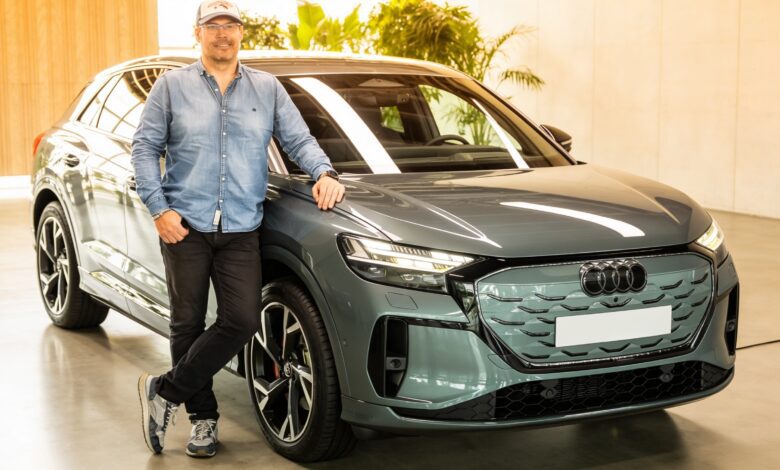
The updated Audi Q4 e-tron 2026 is entering the Spanish electric vehicle market—a model that not only tweaks the details but takes several significant steps forward. In an era when premium electric SUVs are increasingly in demand, Audi is betting on a combination of extended range, faster charging, and a new digital interior. This is not just a facelift, but an attempt to strengthen its position in a segment where competition only intensifies each year.
Technology and design: a focus on practicality
Externally, the Audi Q4 e-tron 2026 features sharper lines, shortened front overhangs, prominent wheel arches, and larger wheels. The signature Singleframe grille is now painted in the body color, giving the car a more modern and streamlined appearance. At the rear, the roof spoiler stands out, along with a black strip that visually separates the roof from the rest of the body—a distinctive touch for dynamic SUVs. The trunk volume is 515 liters, expanding to 1,487 liters with the seats folded down, making the model one of the most practical in its class.
Lighting technology has also reached a new level: digital daytime running lights allow you to select a lighting signature via the MMI, and second-generation OLED rear lights use 284 segments to improve safety and recognition on the road.
Digital interior and new technologies
The main change inside is a fully digital interior. The driver is greeted by an 11.9-inch instrument panel and a 12.8-inch MMI touchscreen oriented toward the driver. An optional 12-inch display is available for the passenger — the largest among all Audi models. The quality of materials has noticeably improved: scratch-resistant surfaces are used in the trim, and sport seats now come standard. The atmosphere is enhanced by extended LED ambient lighting.
In terms of digital services, the 2026 Audi Q4 e-tron offers Android Automotive integration, a proprietary app store, an AI-powered voice assistant, and ChatGPT support. For devices, there are two cooled wireless charging pads, each delivering 15W. The rear row benefits from the electric platform: ample legroom, four USB-C ports (two optional for the second row), and an additional 25 liters in interior storage compartments.
Powertrains, charging, and versions
The engine range includes three options. The base 2026 Audi Q4 e-tron is equipped with a 150 kW motor (350 Nm) and a 63 kWh battery (59 kWh usable), providing up to 442 km of range (452 km for the Sportback). The performance version offers 210 kW (545 Nm) and an 82 kWh battery (77 kWh usable), reaching 582 km on a single charge (595 km for the Sportback). The top all-wheel-drive quattro delivers 220 kW, accelerates from 0 to 100 km/h in 6.2 seconds, and covers up to 561 km (575 km for the Sportback). The maximum speed is limited to 180 km/h.
Charging has become noticeably faster: with up to 165 kW DC, the battery charges from 10% to 80% in just 28 minutes, and in 10 minutes you can get up to 185 km of range. An important innovation is bidirectional V2L charging: the car can power external devices via a 230V outlet in the trunk or an adapter in the side port, delivering up to 2.3 kW of power.
Configurations, pricing, and market position
Standard equipment includes a parking assistant, adaptive cruise control, lane keeping and departure systems, traffic sign recognition, driver fatigue monitoring, and an extended active safety suite. In Spain, prices start at €49,970 for the version with a 63 kWh battery. The performance version is priced from €55,570, and the quattro starts at €58,570. The Sportback body will cost an additional €2,100.
Compared to other premium electric crossovers, the Audi Q4 e-tron 2026 stands out for its balance of range, charging speed, and cabin digitalization. The model targets those looking for a modern electric car with a practical interior and a wide range of technologies, but who are not willing to compromise on quality or equipment. In this sense, the Q4 e-tron 2026 becomes one of the most compelling offers in its segment for the Spanish market.
Interestingly, the trend toward electrification and advanced technology in the premium segment is also confirmed by other new models: for example, the Peugeot 408 2026 also focuses on expanding its electric lineup and updated design, as detailed in the article about the launch of the Peugeot 408 2026 on the Spanish market.
For reference: the Audi Q4 e-tron is a compact premium electric crossover that has secured a prominent position in the urban and family electric SUV segment since its launch. The model competes with players such as the Mercedes-Benz EQA, BMW iX1, and Volvo XC40 Recharge, and is traditionally popular among buyers who value the combination of German engineering, prestige, and modern technology. The 2026 update aims not only to maintain interest in the model but also to strengthen Audi’s position amid growing competition in Spain.