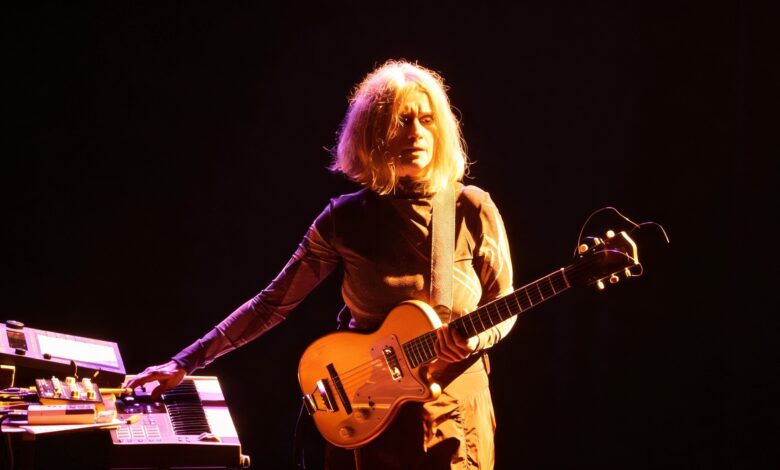
The final concert of Juana Molina’s European tour took place in Barcelona. Molina is an Argentine singer and actress, known for her experimental approach to music. The artist presented a new album, Doga, her first release with new songs in the past eight years. The event attracted great interest: Upload Hall was packed, and many in the audience were her compatriots, underscoring the international resonance of her work.
Experimentation and live sound
Juana Molina does not confine herself to the standard boundaries of electronic music. On stage, she combines synthesizers, acoustic and digital percussion, as well as guitar parts, which she records and plays back in real time. Her vocals, often processed with effects, create a unique atmosphere—the lyrics are hard to make out, but the recurring phrases and sound loops give rise to a recognizable style. That evening, the compositions sounded rawer and more energetic than in studio recordings, and at times the rhythms evoked Argentine folklore, especially in the guitar lines.
Humor and unexpected details
The concert stood out not only for its musical experiments but also for Juana Molina’s signature humor. She commented on what was happening on stage, sometimes singing technical operations with her equipment, which gave the performance a light-hearted feel. Special attention was drawn to the story behind the Desinhumano music video: the singer shared that some frames from the video were hand-painted and put up for sale as unique artworks, though she did not perform the song that evening. The cover of the album Doga also became a topic of discussion — it features a dog with a hairstyle resembling Juana herself, highlighting the artist’s ironic approach to her own work.
Audience reaction and atmosphere
The audience actively supported the artist, responding to every joke and musical twist. Some tracks, such as Cara de espejo, Ay, no se ofendan, and Un dia, sparked a real dance surge in the hall. Even those songs that hinted at pop elements sounded unconventional — more in the spirit of Radiohead than traditional pop. Juana Molina deliberately avoids straightforward solutions, preferring to explore unexpected angles and create multilayered musical structures.
Context and significance
The final concert in Barcelona was not only the conclusion of the tour but also proof that interest in experimental music in Spain remains strong. According to RUSSPAIN, audiences in major cities are increasingly choosing unconventional formats and artists capable of surprising them. Against this backdrop, it’s worth noting that Barcelona’s cultural life remains vibrant: recently, another high-profile episode was discussed in the city — an incident involving a Vox deputy in the Congress, which also sparked widespread public reaction.
Juana Molina once again proved that her music defies classification and can unite people from different countries and generations. Her performance in Barcelona was a significant event for fans of the contemporary scene and those seeking new musical experiences.