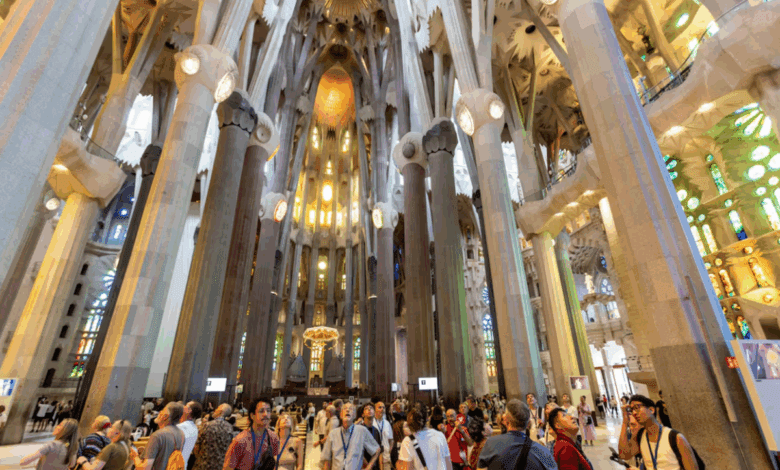
Barcelona has witnessed a historic moment: the completion of the tallest tower of the Sagrada Familia has transformed the city’s iconic skyline. This milestone not only marks the end of a lengthy phase of construction, but also highlights Spain’s significance in global architecture. The new height of the basilica has sparked discussions among residents and experts alike, as Barcelona now boasts a unique landmark visible from any part of the city.
The final touch
On Friday morning, the crowning piece— the upper section of the cross— was installed atop the Jesus (Jesús) tower. The operation began at 9:00, when massive machinery hoisted the component, secured by four cables. By 10:38, the element had started its ascent, reaching its designated spot in less than half an hour. The structure now stands 172.5 meters tall, making Sagrada Familia the tallest church in the world. According to El Pais, this was only possible once the weather allowed work to resume: due to strong winds, installation had been delayed for a week.
The installation of the final element took place before numerous onlookers gathered both inside and outside the building. The process was followed not only by witnesses on site, but also by thousands online: the event was livestreamed on social media, and unique aerial footage was captured by drone. Inside the tower itself, work is still ongoing— scaffolding needs to be removed and the interior finish completed.
Technical details
The upper part of the cross installed on this day weighs over 12 tons. It was prepared in advance: for two weeks, craftsmen worked on the metal frame and installed glass elements at a height of 35 meters. An experienced crane operator was responsible for the precise installation, working at a height of 140 meters. His task was to lift the massive structure using a boom up to 200 meters long. At the very top of the cross, climbers were waiting to fix the component in place. In total, a team of 150 specialists was involved in coordinating the work.
The cross crowning the tower stands 17 meters tall and 13 meters wide. Made of white ceramics, its surface consists of 15,000 individual pieces shaped in 500 unique molds and in seven shades of white. According to Antoni Gaudí’s vision, sunlight should reflect off the cross, making it visible during the day. In recent months, builders installed the structure in stages: first the lower piece, then four side elements, and only now the final upper segment.
An architectural record
Since October last year, when the Sagrada Familia reached a height of 162.9 meters, the basilica has become the tallest church in the world, surpassing the church in Ulm, Germany. Unlike most buildings, the construction of the Sagrada Familia progressed unevenly: over 140 years, the structure grew in stages rather than rising quickly. Antonio Gaudí managed to complete the Nativity facade and the Bernabé tower to show investors and locals what the future cathedral would look like. Now, a century after the architect’s death, the main parts of the building are finished: the Nativity and Passion facades, the Apostles’ towers, four Evangelists’ towers, the Maria tower unveiled in 2021, and now—the tower of Jesus.
The unveiling of the new tower is timed to mark the centenary of Gaudí’s death. Pope León XIV has been invited to the official ceremony, although the Vatican has not yet confirmed his attendance. According to El Pais, the event has generated significant interest not only among Barcelona residents but also among visitors who have come to see the renewed basilica.
Context and related events
In recent years, Spain has been actively completing long-term construction projects that have shaped the face of its cities for decades. For example, in 2024, Madrid finished the reconstruction of the Torre Espacio, while Valencia unveiled a new dome for its cathedral. Projects like these have become symbols of renewal and attract the attention of tourists. Across Europe, there is also a trend toward restoring historic landmarks: in France, the spire of Notre-Dame was rebuilt after the fire, and in Germany, restoration of the Cologne Cathedral continues. Such events highlight the importance of architectural heritage for national identity and the development of tourism.