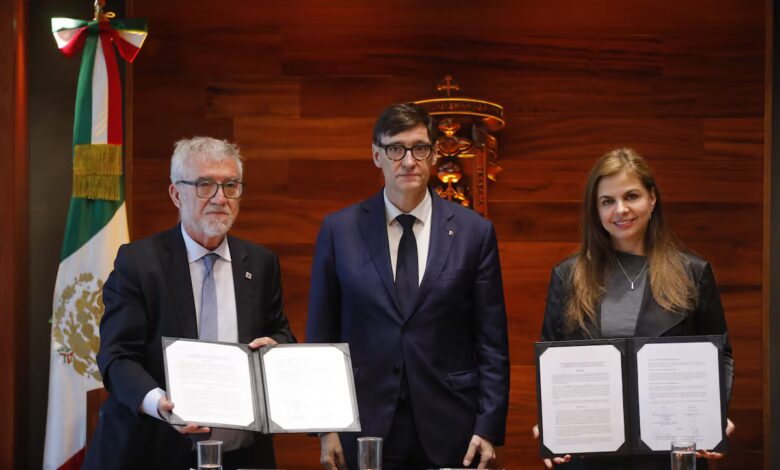
A new phase of scientific partnership has begun in Barcelona and Guadalajara: the supercomputer MareNostrum and its Mexican counterpart, Leo Átrox, are now officially linked by a cooperation agreement. The document was signed by representatives from the Barcelona Supercomputing Center (Barcelona Supercomputing Center, BSC-CNS) and the Data Analysis and Supercomputing Center at the University of Guadalajara (Centro de Análisis de Datos y Supercómputo, CADS). Immediate plans include student exchanges, joint educational programs, and the development of innovative projects.
Despite the difference in computing power—MareNostrum is several times more powerful than its Mexican colleague—both sides are confident that the partnership will bring substantial benefits. Leo Átrox is still ramping up, delivering around 500 teraflops, while MareNostrum has already reached 215.4 petaflops and is aiming for 314. Even with this disparity, the potential for collaboration is enormous.
Technology exchange
Catalonia’s MareNostrum has long been a hub for scientists from around the world. Its resources are used for research in astrophysics, biomedicine, energy, and other fields. Among its projects are the development of an HIV vaccine and modeling of thermonuclear fusion processes. As a result, a whole ecosystem of scientific startups and companies has grown up around the center.
In Guadalajara, often called the Silicon Valley of Mexico, such infrastructure is only just beginning to be developed. For the region, it’s important not only to increase Leo Átrox’s computing power, but also to build a community of researchers, engineers, and entrepreneurs around it. The Catalan experience is especially valuable here: MareNostrum has already gone down this path and is ready to share its expertise.
Educational opportunities
One of the first steps will be an exchange of students and professors. Already, half of the foreign researchers who have worked in Barcelona came from Mexico, mostly from the state of Jalisco. For young scientists, this is a chance to access cutting-edge technology and work in international teams.
Carla Planter, rector of the University of Guadalajara, believes the agreement will help CADS upgrade its equipment and become a technology hub for universities across Latin America. The plans go beyond education to include joint scientific publications, participation in international grants, and the creation of new research groups.
Investment and development
Manuel Valero, director of BSC-CNS, notes that developing supercomputers requires ongoing investment and regular hardware upgrades. In Latin America, he says, only Brazil and Mexico can compete with European centers, but they are still far from reaching Catalonia’s level. The new agreement should speed up this process and draw the attention of local authorities to the need for science funding.
The authorities of Jalisco have already announced their readiness to support the development of CADS. According to Mara Robles Villaseñor, head of the Center for Economic and Administrative Sciences, the university should become a think tank uniting business, government, and the academic community. This approach will help create a sustainable innovation ecosystem.
The future of cooperation
For both sides, this is not just an exchange of experience, but a strategic move toward forming a unified scientific space between Europe and Latin America. There are plans to establish an Ibero-American supercomputing commission that will bring together the region’s leading centers. The Catalans are ready to share technologies, and the Mexicans are eager to attract young talent and develop their own projects.
The first results of this partnership will become evident in the coming years: new research programs, joint publications, and possibly the emergence of new tech startups. For Catalonia, this is an opportunity to strengthen its position on the international scientific scene, while for Mexico it’s a chance to accelerate digital transformation and reach a new level in high-tech development.