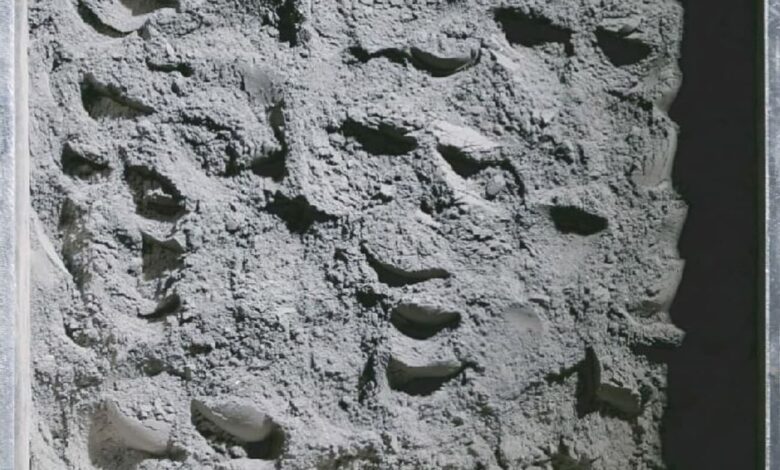
In 2024, the Chinese probe Chang’e-6 delivered soil samples from the far side of the Moon to Earth, specifically from the South Pole–Aitken region. This area is known as one of the Moon’s oldest and largest craters, easily seen from orbit as a dark spot in the southern hemisphere.
Previously, scientists had already encountered a surprising discovery: lunar samples contained traces of magnetite and other iron oxides. This raised questions, since the Moon is almost devoid of free oxygen required to form such compounds. For a long time, it was believed these substances could only appear after contact with Earth’s atmosphere.
However, new research using advanced non-contact techniques has allowed scientists to rule out the influence of Earth’s conditions. Chinese experts used laser irradiation and an ion scalpel to obtain cross-sections inside the soil particles, then studied their structure with an electron microscope. This approach ensured experiment purity and revealed the inner structure of the minerals.
The analysis revealed crystals of hematite and maghemite forming deposits on other minerals. These formations could not have developed in a short time in the laboratory, confirming their lunar origin. This prompted a key question: how do iron oxides form on a satellite that lacks an atmosphere?
Researchers have concluded that large asteroid impacts play a key role. When a celestial body collides with the lunar surface, oxygen is released from minerals, creating a temporary cloud where iron can oxidize. Additional evidence for this hypothesis comes from the presence of a glassy silica film covering the crystals—it forms when rocks vaporize during the impact.
Solar radiation usually destroys such compounds, but in the South Pole–Aitken Basin, radiation intensity is lower due to the region’s particular orientation. Furthermore, this area registers magnetic anomalies that may shield minerals from cosmic particles. Scientists suggest that the presence of maghemite is linked to these magnetic features, as maghemite generates its own magnetic field.
The discovery by Chinese researchers changes our understanding of chemical processes on the Moon. It is now clear that even in the absence of atmosphere and water, complex iron compounds can form on the lunar surface. This opens new perspectives for studying the Moon’s evolution and the processes taking place on other airless bodies in the Solar System.