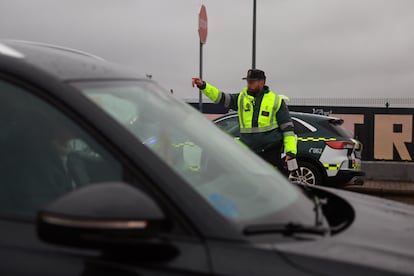
Madrid has tightened road safety controls: In Móstoles, officers from the Guardia Civil regularly catch drivers attempting to take the licensing exam despite being disqualified or lacking a valid license. These measures are a response to the growing number of offenders, which directly affects the safety of all road users.
According to El Pais, last year alone, 70 people in the region were detained for arriving at the test center in their personal cars without a valid license. Operations take place several times a week, with dozens of officers checking all drivers approaching the exam center. Special attention is paid to those previously disqualified by court order or who have completely used up their points.
Exam crackdown
Checks begin early in the morning, when temperatures drop to zero and wet snow appears on the roads. Officers in reflective vests stop all private vehicles, except for driving school cars and public transport. Parents bringing children to the theory exam are often surprised when asked to show their documents. The check takes just a couple of minutes, but if a violation is found, the car is blocked and the driver is taken to the office to file a report.
Offenders are informed that their actions fall under Article 384 of the Spanish Penal Code, which provides for up to six months in prison, heavy fines, or community service. After detention, a fast-track court hearing is scheduled, usually taking place in the coming days in Móstoles.
Schemes involving stand-ins
In addition to drivers without licenses, GIAT (Grupo de Investigación de Accidentes de Tráfico) officers also identify those trying to take the exam for someone else. For this, offenders use wigs, fake mustaches, and carefully forged documents. Sometimes several people acting in collusion are detained in the exam room at once. In one case, one of the detainees tried to escape, hiding a fake document behind a hand dryer in the restroom.
According to officers, such groups operate throughout the country, moving between cities and staying in expensive hotels near examination centers. Document forgery and involvement in these schemes are prosecuted under separate criminal articles, and if offenders resist arrest, they may also be charged with assaulting law enforcement officers.
Fraud involving foreign licenses
Another pressing issue is the widespread attempt to exchange fake foreign driver’s licenses for Spanish ones. In 2025, one DGT office alone on Arturo Soria street identified 400 cases of forged documents being submitted. Most often, these cases involve citizens from two Latin American countries, the names of which are withheld for the sake of the investigation.
The scheme is simple: the applicant submits documents via the DGT website, after which the agency contacts the consulate for verification. However, most cases of forgery are uncovered during the in-person visit and when the original documents are checked. Sometimes, these drivers are already working for VTC services, posing additional risks for passengers and other road users.
On certain weeks in Madrid, up to eight people a day were detained. After stricter controls were introduced, some fraudsters moved to other regions, where inspections are now also being conducted.
In recent years, Spain has seen a rise in cases involving fake driving licenses and attempts to pass exams using stand-ins. In 2024, Barcelona and Valencia also reported mass arrests following similar schemes. Authorities are increasing cooperation between regions and sharing information about suspicious individuals. According to RUSSPAIN.COM, such operations not only improve road safety but also help identify organized groups operating nationwide.