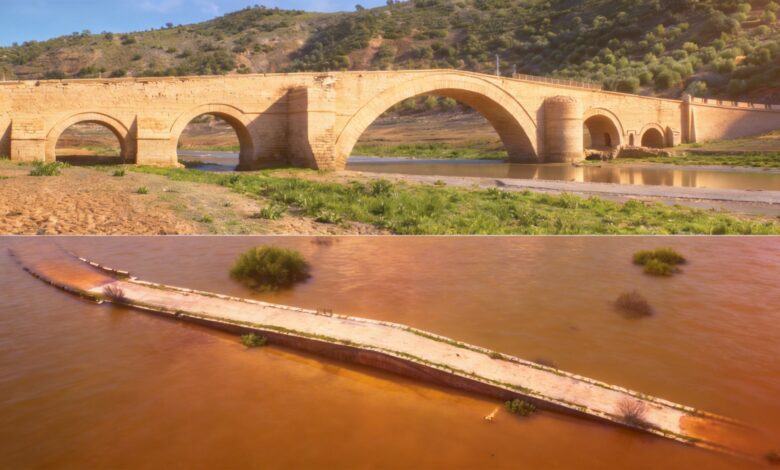
In Spain, the issue of preserving cultural heritage has resurfaced as a pressing concern: the Ariza bridge in Jaén, built in the 16th century, is now almost completely submerged due to sudden floods and the overflowing Giribaile reservoir. For the region, this is more than just the loss of an architectural landmark — the disappearance of the bridge could become a symbol of official inaction and the erosion of historical memory, causing alarm among locals and heritage protection experts.
According to El Pais, water levels in the Giribaile reservoir have reached 75% after prolonged rainfall, leading to the flooding of the Ariza bridge — one of the main engineering achievements of the Renaissance, designed by architect Andrés de Vandelvira. The 100-meter bridge, with its five arches, was a key transport artery between southern Spain and Castile. Now, only fragments of the structure are visible, prompting locals and tourists to hurry and see what’s left before it disappears completely.
Historical significance
The Ariza bridge was only recognized as a national heritage site two years ago, when it was granted Bien de Interés Cultural (BIC) status. This decision required the state to ensure its preservation, but in practice, protection measures have proven insufficient. Although a project to relocate the bridge was approved back in 1998, work has never begun. Over the years, various plans have been discussed — from fully moving it to reinforcing the structure in place — but none have been implemented.
In 2021, the Andalusian government conducted a survey of the bridge’s condition and concluded that it could be preserved in its current location, provided regular strengthening work was carried out. However, the current situation indicates that these measures were not fully implemented. According to russpain.com, such uncertainty regarding the fate of heritage sites often leads to their gradual deterioration, especially if they are in high-risk areas due to natural factors.
Authorities and public response
Local authorities and community organizations have repeatedly raised the need for urgent action. Antonia Olivares, the mayor of Úbeda, where the bridge is located, emphasizes that granting heritage status is only the first step—real protection requires concrete decisions. Representatives of the Guadalquivir River Basin Confederation point out that moving the bridge is extremely complicated due to its status and technical constraints. Meanwhile, the Ariza bridge remains on the list of endangered sites compiled by the Hispania Nostra Association.
A similar situation can be seen with other landmarks in Jaén: part of the 11th-century Arab wall at Iznatoraf was also damaged during recent storms, and in Segura de la Sierra, a section of the ancient fortress wall collapsed. Local authorities are facing bureaucratic obstacles and a lack of funding, which hamper restoration work. As El Pais notes, such cases are becoming more frequent amid climate change and insufficient attention to heritage conservation.
Preservation challenges
There are examples of successful monument relocations in Spain’s history: in 1969, the Roman bridge Alconétar was moved to save it from flooding during the construction of the Alcántara dam. However, such cases are rare, and each time the process requires significant resources and coordination between various agencies. In the case of the Ariza bridge, the lack of a unified strategy and prolonged disputes between state and regional authorities only worsen the situation.
The issue of preserving historical sites in Spain is becoming increasingly urgent. Recent events in Jaén show that without clear and timely decisions, unique landmarks can be lost forever. Against this backdrop, public attention to the problem is growing not only among experts but also among the general public, as evidenced by the number of visitors eager to see the Ariza bridge before it disappears completely.
Other regions of the country have also seen monuments damaged by natural disasters and a lack of effective protective measures. For example, in Extremadura, new evidence has recently emerged in a disappearance case, drawing attention to issues of safety and preservation of historical sites — more details can be found in the article about new discoveries in Hornachos.
In recent years, Spain has seen a rise in cases where architectural landmarks are threatened by extreme weather events. In 2023, several medieval bridges in Castile and León were damaged by floods, while parts of historic walls and towers collapsed in Andalusia. Experts warn that without a systematic approach to heritage preservation and increased investment in restoration, the situation will only worsen. Funding challenges, bureaucracy, and lack of coordination between agencies remain key obstacles to protecting these unique cultural sites.