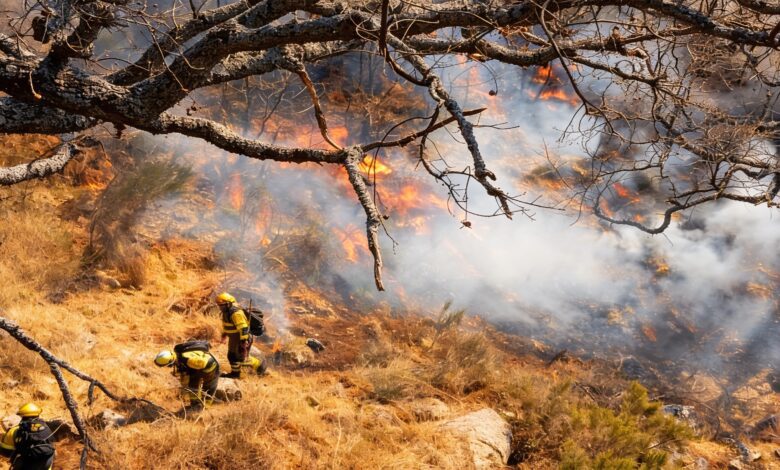
A serious wildfire in the northern part of the province of Cáceres has raised alarms among residents of Extremadura. In a short period, the fire has consumed about 200 hectares of forest and shrubland, potentially causing long-term damage to the region’s ecosystem and local farmers. The situation is further complicated by the fire’s proximity to specially protected natural areas, sparking concerns about the preservation of unique landscapes.
According to El Pais, the blaze started in a remote area near the town of Losar de la Vera, not far from the Garganta de los Infiernos nature reserve. Although the reserve itself has not been affected so far, the fire continues to spread, mostly impacting oak groves and dense undergrowth. Preliminary investigations suggest that the cause was unauthorised pasture burning carried out by local livestock farmers to renew grassland.
Limited access and equipment
Firefighting efforts are hampered by difficult terrain—both equipment and personnel are struggling to reach the epicenter of the blaze. Four helicopters are on scene: two regional and two provided by the Ministry for Ecological Transition, along with two amphibious planes. The operation also involves ground and aerial fire units, environmental specialists, and technical fire suppression experts. Local authorities report that emergency crews are working in extremely challenging conditions, with access to some areas nearly impossible.
The mayor of Losar de la Vera, Antonio Sánchez, emphasized that firefighters are forced to work in extreme conditions, where each hour of delay expands the affected area. According to RUSSPAIN.COM estimates, such incidents in the region are not unprecedented and are often linked to traditional farming practices, which do not always meet modern safety standards.
Impact on the region and response measures
The fire has already raised concerns among local residents and farmers, who fear for their land and the future of their pastures. Authorities in Extremadura are urging caution and reminding everyone of the need to strictly follow fire safety rules. The recent surge in such incidents has prompted regional officials to tighten controls over agricultural burning and strengthen preventive measures.
According to El Pais, additional resources have been dispatched to the scene in order to prevent the fire from spreading to particularly valuable natural areas. At the same time, past experiences show that even with prompt action, it takes months—sometimes years—to restore affected territories. Recent cases in other regions of the country demonstrate that prevention and control remain crucial issues.
Context and consequences
Fires of this scale not only devastate natural resources but also impact the economy of rural areas. The loss of pastures and forests affects farmers’ incomes and makes restoring biodiversity more difficult. Similar incidents have been reported in other parts of Spain, such as Aragón, where recent discussions have focused on farm problems related to violations of standards and threats to the environment — details of the investigation in Teruel show that environmental and safety issues remain a priority.
In recent years, Spain has seen an increase in the number of wildfires, especially in arid regions. In 2025, similar incidents occurred in Catalonia and Castilla y León, where damage to nature and agriculture was significant. Experts note that climate change, along with human factors such as careless handling of fire, are among the leading causes of these disasters. Authorities continue to develop new measures for prevention and rapid response, but the challenge requires a comprehensive approach and the involvement of all stakeholders.