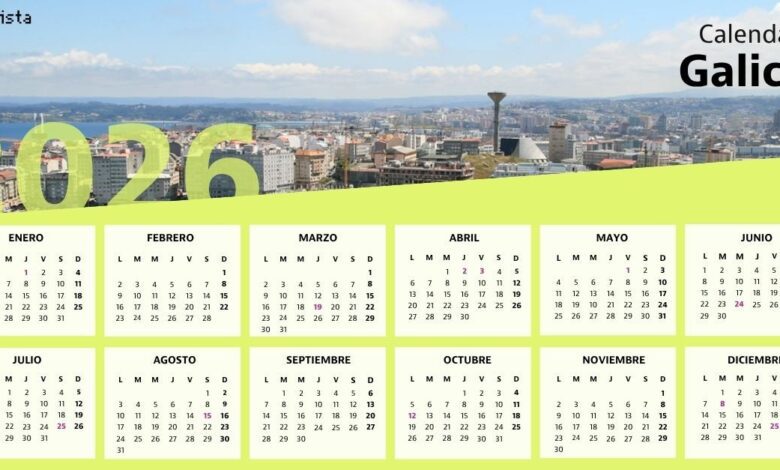
The government of Galicia (Xunta de Galicia) has officially released the 2026 work calendar, which will serve as a guide for work schedules and holidays for all residents of this autonomous community. In total, Galicians will have fourteen public holidays. This number includes both national Spanish holidays and unique regional and local festivities that reflect the rich culture and traditions of Galicia.
The 2026 holiday calendar offers residents of the region plenty of opportunities for short getaways and long weekends. Twelve of the approved holidays are observed throughout Spain, while each province and municipality designates two additional days based on their own local traditions and the celebrations of their patron saints.
National public holidays in 2026
Residents of Galicia, like those elsewhere in Spain, will have days off on the following dates:
January 1 (Thursday) – New Year’s Day. Traditionally, many gather in Obradoiro Square in Santiago de Compostela to eat 12 grapes as the clock strikes midnight, then continue the celebration with family or friends.
January 6 (Tuesday) – Epiphany, or Three Kings’ Day. On this morning, children find gifts, and families gather to enjoy the traditional ‘roscón de Reyes’ cake.
April 3 (Friday) – Good Friday. Many towns and villages hold solemn processions and theatrical performances reenacting the Passion of Christ.
May 1 (Friday) – Labor Day. In major cities of Galicia, as in the rest of the country, demonstrations and rallies are held to mark International Workers’ Solidarity Day.
August 15 (Saturday) – Assumption of the Virgin Mary. The day is observed with church services, processions, and popular festivities featuring traditional music and dancing.
October 12 (Monday) – National Day of Spain. The celebration includes various events, food fairs, and parades.
December 8 (Tuesday) – Immaculate Conception of the Virgin Mary. A religious holiday marked by masses, processions, and musical performances.
December 25 (Friday) – Christmas. In Galicia, this day features unique traditions such as the figure of Apalpador (the local equivalent of Santa Claus), and of course, festive tables with typical regional dishes.
Regional Holidays in Galicia
In addition to national holidays, there are four additional days that are public holidays exclusively in Galicia:
March 19 (Thursday) – Saint Joseph’s Day (San Xosé), which is also celebrated as Father’s Day in Spain. It is marked by church services and family gatherings.
April 2 (Thursday) – Maundy Thursday. This day, which precedes Good Friday, is also a public holiday, giving locals the opportunity to fully participate in religious celebrations.
June 24 (Wednesday) – St. John’s Day (San Xoán). One of the brightest nights of the year, when bonfires light up the coast, people jump over the flames, and the air is filled with the aroma of grilled sardines.
July 25 (Saturday) – National Day of Galicia. The region’s main holiday, marked by official ceremonies, a solemn mass at the cathedral in Santiago de Compostela, and numerous cultural events.
Local Holidays in the Provinces
Each of Galicia’s four provinces and its capital add their own unique holidays to the calendar:
A Coruña Province: February 17 (Tuesday) – Carnival; October 7 (Wednesday) – Feast of the Virgin of the Rosary.
Lugo Province: February 17 (Tuesday) – Carnival; October 5 (Monday) – Feast of St. Froilán, the city’s patron saint.
Ourense Province: February 17 (Tuesday) – Carnival; November 11 (Wednesday) – St. Martin’s Day, celebrated with the traditional “magosto” chestnut festival.
Pontevedra Province: February 18 (Wednesday) – Ash Wednesday, marking the end of Carnival; July 11 (Saturday) – St. Benedict’s Day.
Santiago de Compostela: February 17 (Tuesday) – Carnival with the symbolic ‘burial of the sardine’; May 14 (Thursday) – Ascension Day, celebrated with fairs, concerts, and food festivals.
For reference, Galicia is an autonomous community in the northwest of Spain, renowned for its Celtic heritage, lush green landscapes, and rugged coastline featuring picturesque fjord-like inlets called rías. The region has its own official language—Galician—which is closely related to Portuguese. The capital, Santiago de Compostela, is the final stop on the famous Camino de Santiago pilgrimage route and draws hundreds of thousands of tourists and pilgrims from around the world each year.