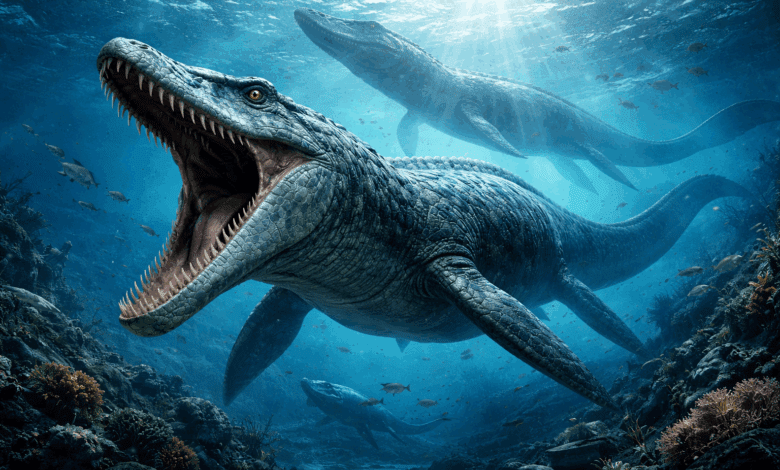
For a long time, mosasaurs were seen solely as rulers of the ancient seas, but new evidence is challenging that view. A team of paleontologists from Sweden, the US, and the Netherlands analyzed isotopes in mosasaur teeth discovered in North Dakota. The results were surprising: these giant reptiles were not limited to saltwater—they freely inhabited freshwater rivers too, where they could have posed a threat even to dinosaurs.
During their research, scientists studied teeth found in river sediments far from the coast. One of these teeth belonged to an individual about 11 meters long—comparable in size to modern orcas. This discovery changes our understanding of how dangerous ancient waterways were: it’s now clear that even in freshwater rivers, dinosaurs could fall prey to massive predators lurking by the water.
Paleontologists note that such findings force us to rethink Late Cretaceous ecosystems. While it was once believed that mosasaurs never left the seas, it is now clear they were far more adaptable and capable of thriving in diverse environments.
Unexpected Discoveries
In 2022, a mosasaur tooth was discovered in a riverbed in North Dakota alongside a Tyrannosaurus rex tooth and a crocodile jaw. This raised the question: could mosasaurs live in freshwater, or were their remains simply carried there by currents from the sea? To find the answer, scientists conducted an isotope analysis of the tooth enamel and compared it with other fossils, including shark and ammonite teeth.
Isotopes of oxygen, strontium, and carbon help determine the environment where an ancient organism lived. Oxygen, for example, distinguishes between seawater and freshwater: rivers contain more of the lighter isotope 16O, while seas have more of the heavier 18O. Analysis showed the mosasaur tooth carries a clear ‘freshwater’ isotopic signature, confirming its adaptation to river habitats.
Additional teeth found at nearby sites showed similar isotopic characteristics. This suggests mosasaurs were not accidental visitors to freshwater, but truly inhabited these environments for millions of years leading up to their extinction.
Diet and behavior
Isotope analysis not only confirmed their habitat, but also shed light on the diet of these predators. The carbon ratio in mosasaur teeth exceeded that of other known marine reptiles, dinosaurs, and crocodiles. This may indicate the mosasaur did not dive deep, hunting instead in upper water layers—possibly even feeding on dinosaur carcasses that ended up in the river.
Paleontologists suggest that the transition to freshwater habitats was one of the final adaptations of mosasaurs before the mass extinction event. This allowed them to expand their range and exploit new food sources, making them even more dangerous to other animals around them.
All this points to the high flexibility and adaptability of mosasaurs, who managed to occupy a unique ecological niche in the late Cretaceous period. Their ability to survive in diverse conditions made them some of the most successful predators of their age.
Shifting perspectives
The discovery of freshwater mosasaurs changes not only our understanding of these reptiles themselves but also the entire ecosystem of the late Cretaceous. It is now clear that danger for dinosaurs lurked not only on land but also in water. Bodies of water previously considered relatively safe could have harbored giant predators ready to strike at any moment.
The appearance of mosasaurs in rivers may have influenced the behavior of other animals, forcing them to be more cautious when approaching water. It could also have altered food chain structures and competition between species, ultimately shaping the development of the region’s entire fauna.
Research is ongoing, and scientists do not rule out that new evidence of freshwater mosasaur populations will be found elsewhere in the world. This opens up new horizons for studying the evolution of ancient marine reptiles and their interactions with the environment.
If you didn’t know, mosasaurs were extinct marine reptiles that lived at the end of the Cretaceous period, around 98 to 66 million years ago. They belonged to the order Squamata and were related to modern monitor lizards and snakes. Mosasaurs ranged in length from 3 to 17 meters and were considered among the most dangerous predators of their era. Their fossils have been found on every continent, indicating that these reptiles had a wide distribution in ancient seas and, as has now been discovered, in rivers as well.