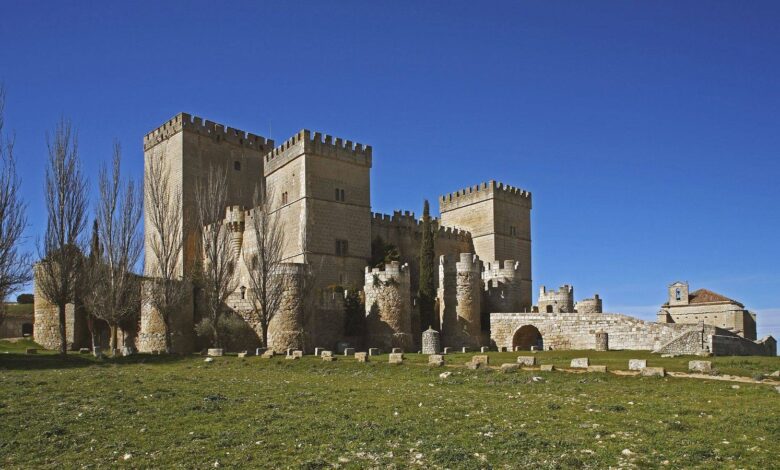
Amid the endless fields of southern Palencia stands a medieval fortress that, despite its historical importance, remains overlooked by many travelers. This enclave, recognized as a Site of Cultural Interest, has silently witnessed pivotal political decisions that shaped Spanish history. A winter visit allows you to fully experience its solemn atmosphere, far from tourist crowds, and to connect with a past where power and Gothic architecture went hand in hand.
This is the Ampudia Castle, one of the most striking examples of Gothic fortification in Castilla y León and the main landmark of the small town of the same name, home to just over five hundred residents. Built between the 13th and 15th centuries on a slight rise, it dominates the town’s skyline and the surrounding farmland. Its symmetrical facade, flanked by corner towers, ornamental watchtowers, and the coat of arms of the Duke of Lerma above the main entrance, hints at an interior that combines defensive strength with palatial comfort. Crossing the ancient moat via the drawbridge, visitors enter a spacious courtyard where arcades and galleries reveal its palace-like character, typical of late Gothic architecture.
Beyond its architectural significance, the castle is famous for the historic events that unfolded within its walls. In the early 16th century, chronicles report that Charles V stayed here during his first journey through Spain. Shortly after, in 1521, the town was the site of the Battle of Ampudia during the Comuneros’ Revolt. However, the castle played its most decisive role in the early 17th century, when the powerful Duke of Lerma, a favorite of King Philip III, made it his temporary residence and the unofficial center of court life. It was here that negotiations culminated in the 1606 decree transferring Spain’s capital back to Madrid from Valladolid.
After centuries of splendor followed by a long period of neglect, the castle was declared a National Monument in 1931. Its revival began in the 1960s thanks to a major restoration led by entrepreneur Eugenio Fontaneda. Today, the castle houses an invaluable antiques collection—archeological finds, sacred art, weapons, vintage toys, and ethnographic artifacts are displayed on the first floor. From the top of the main tower, Torre del Homenaje, rising over 30 meters, visitors are treated to the best views of Ampudia, where the silhouette of the Collegiate Church of San Miguel and windmills on the horizon create an unforgettable scene, the perfect finale to a cultural excursion.
Notably, the town of Ampudia, home to the castle, is part of the Pueblos Mágicos de España association, highlighting its unique charm and rich heritage. The collection assembled by Eugenio Fontaneda and housed in the castle is considered one of the most significant private collections in the country. It spans a wide range of fields, from Iberian archaeology to Castilian folk traditions. This makes the castle much more than a historical monument—it’s a true museum, where every room tells its own story, offering deeper insight into the culture and daily life of the region.