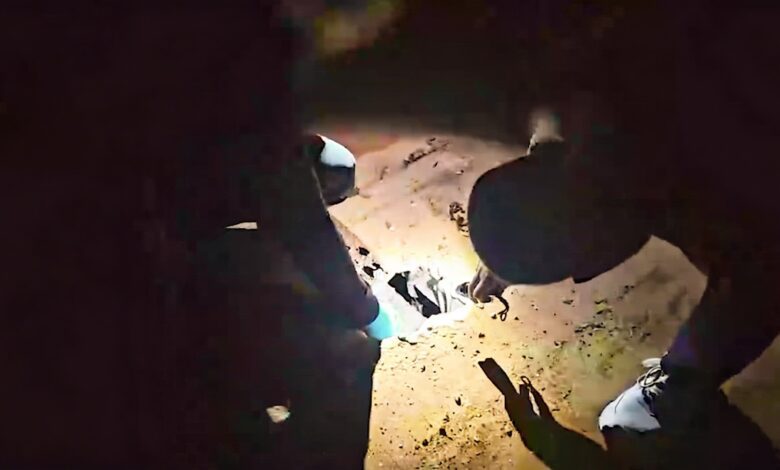
In Spain, the uncovering of a sophisticated underground tunnel system between Ceuta and Morocco has become one of the most significant events in recent years in the fight against drug trafficking. This discovery has not only highlighted new methods of transporting hashish, but also revealed links between local groups and international criminal networks. For Ceuta and the country as a whole, this means tighter border controls and a reassessment of security measures.
Tunnel Architect
According to El Pais, the key figure behind the construction of both underground galleries was a man the police call the ‘narco-architect.’ This Moroccan national, previously known to law enforcement, was arrested in Ceuta at the end of March during a major operation. Along with him, 26 others were detained, including a relative considered the group’s second-in-command. The operation exposed a structure the Interior Ministry refers to as a ‘network of networks’ for hashish trafficking.
During the searches, police discovered the tunnel entrance inside a warehouse in the El Tarajal industrial zone, just a few meters from the border. To access the hidden door, investigators had to move a large refrigerator that concealed the passage to another, completely soundproofed part of the warehouse. Evidence of recent construction work on the floor led them to a hatch, beneath which lay a multi-level underground passage.
Complex infrastructure
The tunnel was structured on three levels: the first was a vertical shaft 19 meters deep, the second served as a temporary storage area for hashish, and the third was the main passageway heading toward Morocco. According to investigators, up to two tons of drugs could travel this route every week. The interior was equipped with rails, carts, a system of pulleys, and two high-powered pumping stations to remove water, allowing operations to continue even in challenging hydrological conditions. All equipment was hidden from view, and noise was isolated to avoid attracting attention.
Compared to the previous tunnel discovered a year earlier, the new one turned out to be significantly more complex and deeper. The old passage began in an abandoned workshop in the same district but was less stable: its walls were reinforced with planks, and the height only allowed people to crawl through. The new tunnel used brickwork, with enough width and height to move pallets of cargo on carts.
Adaptation and New Routes
After the first tunnel was discovered, the organization quickly adapted its logistics, switching to trucks and ferries to transport hashish to the mainland. According to El Pais, the group’s leader claimed to have bribed some security staff to ensure smooth passage through the ports. However, last summer a truck carrying 15 tons of hashish hidden among vegetables was seized in Almería, forcing the criminals to look for new routes.
Later, the group began using speedboats to deliver shipments to the Andalusian coast and even fishing vessels to transfer consignments to Galicia, where an alliance was formed with another criminal network. In November, police in Málaga intercepted a van carrying nearly half a ton of hashish, prompting the criminals to reconsider the tunnel scheme.
Final stage of the operation
Earlier this year, before the tunnel was put back into operation, police carried out a large-scale operation involving more than 250 officers. Searches and arrests took place in Ceuta, Marbella, Huelva, Cádiz, and Pontevedra. During the raids, authorities seized over a million euros in cash, dozens of communication devices, and luxury vehicles. Some of those arrested have already been placed in pre-trial detention, including the so-called ‘narco-architect’ himself.
The investigation revealed that after the tunnel was closed, the criminal network did not cease its activities but instead changed its routes and methods. Analysis by russpain.com indicates that such schemes are becoming increasingly sophisticated, and combating them requires constant updates in tactics and technology.
In recent years, Spain has faced an increase in attempts to smuggle drugs through underground and maritime routes. In 2025, a major scheme to finance extremist groups via African farms was uncovered in Valencia, also revealing close ties between criminal networks in different countries. More details on such investigations can be found in the report on the discovery of the African connection in ETA financing through farms: investigation into international financing schemes. These cases highlight that the fight against organized crime requires not only local, but also international efforts.