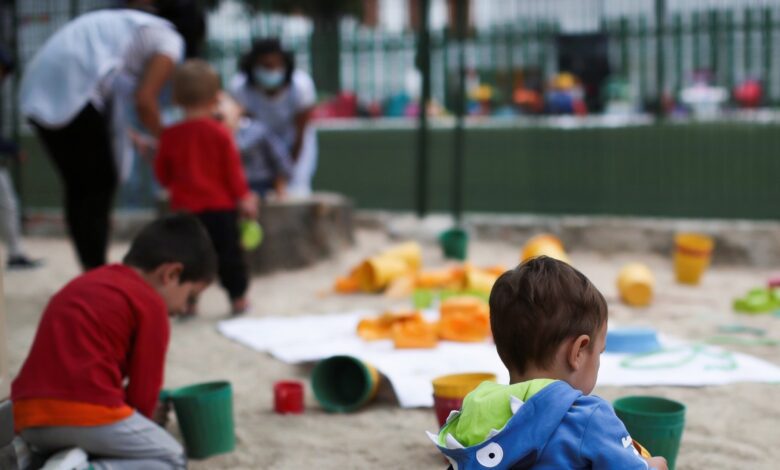
In Madrid, the situation with nurseries for children under three has become one of the most pressing issues in recent years. Parents face confusion when choosing a facility, while educators report overload and unequal conditions. The reason is the lack of a unified system and clear standards, which directly affects the quality of care and the availability of places for families.
As El Pais notes, the label “early childhood education 0-3” conceals at least twelve different types of institutions. The city has public and private nurseries, municipal centers, schools with preschool groups, as well as facilities funded from various sources. Each type differs not only in ownership, but also in standards, working conditions, and even staff requirements.
Different networks — different rules
Regional authorities admit: by 2026, Madrid will fund more than 390 specialized centers, including 264 nurseries and 129 so-called “childminder homes.” There are also 85 public schools with groups for children under three. However, it is hard to call this a unified network — rather, it is an overlap of various networks, each operating under its own rules.
As a result, parents often do not understand who is responsible for quality, who funds the facilities, and who hires the staff. This structure complicates spending oversight, comparing conditions, and assigning accountability for outcomes. According to russpain.com, such fragmentation means that even in neighboring districts, children may receive vastly different levels of care and attention.
Standards and quality
Differences between networks appear not only in management but also in basic standards. For example, regional regulations set a maximum group size: eight infants under one year, fourteen children from one to two years, and twenty from two to three years old. In municipal nurseries in Madrid, requirements are stricter: each group has two caregivers, and the number of children is lower. This means that under the same “nursery” label, the conditions for children can be completely different.
Special attention is paid to the so-called “pedagogical pair” — when a group is supervised by two specialists at once. This approach enables more individual attention, especially when a child is struggling to eat, crying, or just beginning to adjust. Where this is lacking, caregivers are forced to address problems as they arise, which affects the quality of care.
Staffing and funding challenges
Preschool staff regularly report low wages, outdated buildings, lack of materials, and the inability to provide proper care due to large group sizes. These complaints are more than just dissatisfaction; they signal that the system is stretched to its limits. Strikes and protests have become common, with many facilities staying open only thanks to the dedication of their staff.
The wage system also plays a crucial role. In private kindergartens and externally managed institutions, a state collective agreement applies, setting different rates for new and existing contracts. The pay gap can reach up to 220 euros per month, and many contracts offer such minimal hours that even these amounts can’t be met. This causes high staff turnover and lowers motivation.
The impact of the private sector
Private kindergartens are also affected: regional authorities continue to allocate subsidies for education in private centers, officially called scholarships. In practice, these are vouchers received by the center, not the family, leaving parents to pay a significant portion out of pocket. This system increases inequality among families with different income levels.
As a result, a model emerges in which the state system does not disappear, but is also unable to restore order. The authorities continue to experiment with contracts, funding modules, and vouchers, but the problem persists. As El Pais writes, it is children, families, and staff who find themselves at the center of this experiment, forced to deal with the consequences of ineffective management.
A similar situation involving confusion and inequality already occurred in Madrid during the relocation of underage migrants between regions — more details about the problems of child allocation also sparked widespread public outcry.
Context and recent developments
In recent years, reform of Spain’s preschool education system has been the subject of repeated debate. Regional authorities have attempted to introduce new standards, reduce group sizes, and increase salaries for educators. However, a lack of unified policy and differences in funding have led to ongoing instability. In some cities, parents must register a year in advance, while others experience a shortage of qualified specialists. The question of creating a unified network of preschools and equalizing standards remains unresolved and is a subject of debate among experts and politicians.