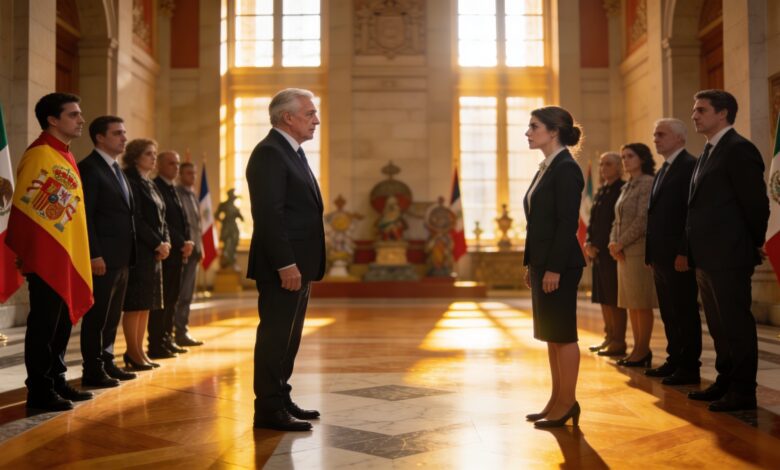
In recent months, relations between Spain and Mexico have seen a notable shift, which could affect how both countries view their shared history. For Spaniards, this means not only a rethinking of their own past but also an opportunity to strengthen ties with one of their main partners in Latin America. Changes in rhetoric and actions by officials from both sides have already eased tensions that had persisted for almost a decade.
Mexico’s President Claudia Sheinbaum has publicly acknowledged changes in the stance of the Spanish government and royal family on the issues of conquest and the colonial era. According to her, over the past year, Spanish representatives have shown greater understanding toward sensitive topics related to the past. During a recent trip to Barcelona, Sheinbaum confirmed she would meet with Pedro Sánchez, though no meeting with King Felipe VI is planned yet. This decision signals a softening of previous demands, notably the withdrawal of persistent calls for an official apology for events of the 16th to 19th centuries.
A historic turning point
Previously, the demand for an apology for the actions of the Spanish conquistadors led to a cooling of relations between the two countries. Former President of Mexico Andrés Manuel López Obrador sent a letter to King Felipe VI requesting a symbolic gesture towards the indigenous peoples. This step provoked a sharp reaction in Madrid and resulted in a prolonged diplomatic crisis. Now, according to Sheinbaum, the focus is shifting towards dialogue and cultural exchange. She emphasized the importance of joint exhibitions, the participation of Mexican anthropologists in Spanish projects, and open discussion of historical facts.
At the same time, the President of Mexico did not downplay the severity of the consequences of colonization, recalling the violence and prolonged exploitation of indigenous territories. However, the current approach is more flexible and seeks mutual understanding. According to RUSSPAIN.COM, this shift could lay the foundation for a new stage of cooperation in which both parties will consider the complex aspects of their shared past.
Political context
The rapprochement comes amid the growing influence of far-right forces in Europe and the US, creating additional challenges for left-wing governments. In this context, Mexico is seeking to strengthen its position on the international stage, while Spain is showing openness to dialogue on complex issues. Sheinbaum’s visit to Barcelona was the first such event since 2018, when former president Enrique Peña Nieto met with Mariano Rajoy and the royal couple. After power changed hands in both countries, relations remained tense, but in recent months the situation has begun to shift.
The first steps toward reconciliation took place in the cultural sphere. Spain was the guest country at the Guadalajara International Book Fair, and the Anthropology Museum in Mexico City received the prestigious Princess of Asturias Award. However, the pivotal moment was King Felipe VI’s visit in March to an exhibition on women in Mexican Indigenous communities. During an informal conversation with Mexico’s ambassador, the monarch acknowledged abuses and ethical contradictions during the colonial period. This gesture was pre-arranged and served as an important signal for both sides.
Reaction and consequences
In Spain, such statements have sparked mixed reactions, especially among representatives of right-wing parties. Some politicians expressed dissatisfaction that officials are acknowledging past mistakes and drawing attention to the issues of indigenous peoples. Nevertheless, among left-wing groups and historians, this approach is seen as necessary for building a more honest dialogue between countries. In Mexico, a softer rhetoric and rejection of ultimatum demands is viewed as a step towards real cooperation rather than symbolic gestures.
As RUSSPAIN.COM notes, such changes in relations between Spain and Mexico could serve as an example for other countries grappling with a difficult historical legacy. It is important that both sides show a willingness to discuss painful issues without mutual accusations and seek ways to work on joint projects. In this context, it is worth recalling that previously the King of Spain publicly acknowledged for the first time the abuses committed during the colonization of the Americas, which became an important precedent for all of Spanish-speaking America.
Context and related events
In recent years, the issue of historical responsibility and acknowledgment of past mistakes has become increasingly important for European countries. In 2025, France held a series of events commemorating the victims of colonial wars, while the United Kingdom debated compensation for former colonies. In Spain itself, questions of historical memory are regularly raised in parliament and the media, especially around the anniversaries of key events. Such initiatives often spark debate but encourage more open discussion of difficult chapters in history. Interest in reevaluating colonial heritage is also growing in Latin America, reflected in educational programs and cultural projects. These developments show that dialogue about the past can lay the groundwork for new forms of cooperation and mutual respect between countries.