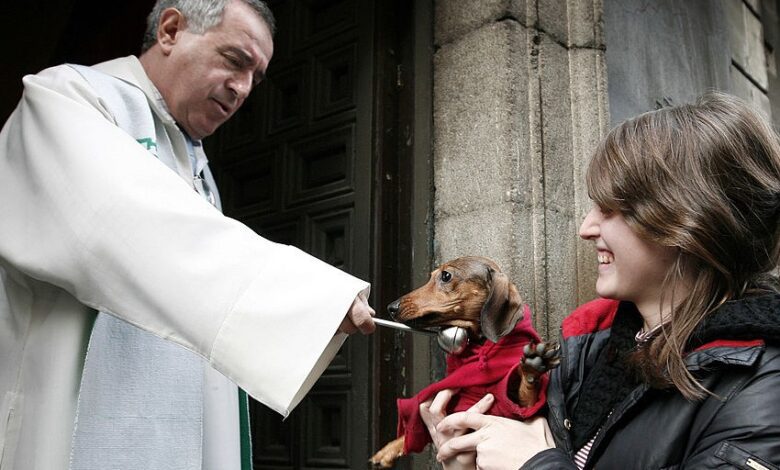
Every January, after the Christmas festivities subside, Spain fills with the smoke of bonfires and the sound of bells in honor of Saint Anthony the Great, the patron saint of animals. Around January 17, extraordinary celebrations unfold across the country where Christian tenets blend closely with pagan rituals, and a love for our four-legged companions takes on an almost sacred meaning. This isn’t just about formal processions—it’s a living, breathing tradition that unites entire cities and villages.
From the bustling streets of the capital to the tranquil villages on the islands, the fiesta of San Antón showcases the incredible diversity of Spanish culture. In some places, giant bonfires shoot flames skyward; elsewhere, horses in antique harnesses clatter across cobblestone streets, and priests bless not just dogs and cats, but also ferrets, iguanas, and even goldfish in their tanks. Let’s take a look at the most colorful and iconic spots where this festival is celebrated in spectacular style.
Madrid’s festive flare and Catalonia’s unique traditions
In Madrid, the celebration of San Antón is centered around the church on Calle Hortaleza, which bears the saint’s name. For several days, this spot becomes a pilgrimage center for thousands of city residents and their pets. People line up long before the service begins to receive the coveted blessing. The city council organizes an extensive program featuring fairs, workshops, and educational events focused on animal welfare. The highlight is the famous ‘vueltas de San Antón’—a colorful parade where proud owners walk their beloved animals to applause and music.
Barcelona, on the other hand, invites you to step into history. In the Sant Antoni district, named after the saint, the ‘Tres Tombs’ cavalcade takes place, with roots tracing back to the 19th century. This impressive procession features carriages drawn by horses and donkeys, which symbolically circle the neighborhood three times. An essential figure of the celebration remains the pig, linked to one of the miracles attributed to the saint. In recent years, local authorities have actively revived forgotten customs, such as the lottery where the main prize was a pig, giving this ancient tradition a modern twist.
Fire, records and ancient rituals
For a true display of fiery madness, head to the Valencian town of Canals. Here, in honor of San Antonio Abad, locals build and ignite a colossal bonfire that’s officially listed in the Guinness Book of Records. Preparation takes weeks, with tons of wood stacked into a monumental structure. On the evening of January 16, the bonfire bursts into flames, illuminating the sky and symbolizing an offering to the patron saint. The following day is devoted to religious ceremonies, while January 18 brings the “day of pairs” (dia dels parells), when festively dressed riders throw toys and sweets from horseback to the crowds lining the city streets.
In the Andalusian city of Jaén, the night of January 16 to 17 is also marked by fire, though here the tradition is deeply rooted in agricultural heritage. Across the city, “lumbres”—bonfires—are lit, once fueled by pruned olive branches leftover from the harvest. Neighbors gather around the flames, sing local verses called “melenchones,” and enjoy regional treats like blood sausage and roasted pumpkin. Since 1984, this ancient custom has been joined by a modern event—the International Night Urban Race, “Night of San Antón,” as runners wind through city streets lit not only by lamplight but by the torches of cheering crowds.
Island demons and southern festivities
One of the oldest and most vibrant celebrations of San Antonio unfolds in Mallorca, in the town of Sa Pobla. Here, local religious traditions blend with pagan rituals, creating a truly explosive mix. The main night is marked by “foguerons”—bonfires symbolizing the triumph of light over darkness. But the real hallmark of the festival is the presence of “dimonis”—participants costumed as demons, representing the temptations of the saint. Their wild dances amid the flames produce a unique and slightly eerie spectacle that’s impossible to forget.
In Cartagena, in the district of San Antón, the festivities last almost two weeks. The celebration combines agricultural fairs, religious ceremonies, and a host of neighborhood events. One of the key traditions is the pilgrimage (romería) in honor of the saint, which has been held since the 19th century. The raffle of a piglet, another ancient ritual, remains a much-anticipated event, preserving a legacy of charity, as funds raised in the past went to help the sick and support the local parish. The food here is also a highlight: everyone samples the special ‘San Antón rolls’ and the famous baked octopus.
Reference RUSSPAIN. Saint Anthony the Great, also known as Anthony the Abbot, lived in Egypt during the 3rd and 4th centuries and is regarded as the founder of Christian hermit monasticism. According to legend, he cured a wild boar (or a pig), after which the animal became his faithful companion. That is why the saint is traditionally depicted with a pig at his feet, and he became the heavenly patron not only of domestic animals, but also of farmers, butchers, and all those who work with animals.