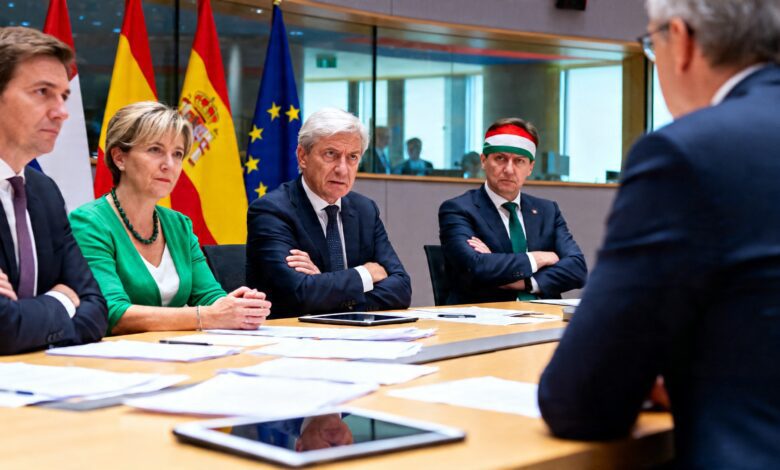
Spain has once again raised the issue of suspending the partnership agreement between the European Union and Israel. At the EU foreign ministers’ meeting in Luxembourg, Spanish Foreign Minister José Manuel Albares officially demanded the complete termination of the agreement. Ireland and Slovenia joined the initiative, and Prime Minister Pedro Sánchez publicly confirmed Madrid’s position. However, despite growing discontent with Israel’s actions in a number of European capitals, the European Union is not prepared to take such a step: unanimity is required, and several countries are opposed.
Division within the European Union
According to RUSSPAIN, a stable coalition of opponents to tough measures against Israel has formed within the EU. Germany remains a key supporter of maintaining the agreement, considering it an important tool for dialogue. It is joined by the Czech Republic, Austria, and Hungary, where Viktor Orbán’s government has traditionally supported Israel’s policies. Uncertainty also remains about the position of Hungary’s new government under Péter Magyar. Italy is likewise inclined to caution, although its relationship with Israel has become less straightforward recently. Among the countries blocking even partial restrictions are Cyprus, Greece, Croatia, Lithuania, Bulgaria, and Romania.
Alternative measures and diplomatic pressure
In the absence of unanimity, the European Commission proposed restricting Israel’s trade privileges, which requires not unanimity but a qualified majority. However, this initiative also failed to gain sufficient support: some countries are unwilling to agree even to partial sanctions. According to diplomats, the discussion of these measures will indicate the mood within the EU, but a breakthrough is not expected. Spain, Ireland, Slovenia, as well as Belgium, the Netherlands, France, Luxembourg, Portugal, Sweden, Finland, and Denmark support a tougher policy, although not all are ready to back Madrid and Dublin’s most radical proposals.
Pressure strategy and the role of the agreement
Madrid believes that even without immediate results, the constant return to the subject of sanctions is gradually changing the atmosphere in the EU. Since February 2024, Spain and Ireland have been seeking to use the agreement’s mechanisms to put pressure on Israel, emphasizing that the document requires compliance with international law. In July 2025, ministers already discussed partial suspension of the agreement, but there were not enough votes at that time either. In September, the European Commission again proposed limiting trade concessions, but this measure also failed.
Context and consequences for Spain
The agreement between the EU and Israel grants the latter special access to the European market, but also includes obligations to comply with international standards. For Spain, this issue is not only political, but also economic: a change in the agreement’s status could impact trade and investment. It is worth noting that similar difficulties in reaching consensus within the EU have arisen over other matters as well, such as during discussions about budget cuts at universities, as recently happened in Seville — more details can be found in the article about the financial difficulties of Andalusian universities.
No drastic decisions are expected in the near future: most EU countries prefer to maintain the current format of relations with Israel, despite pressure from Spain and its allies. However, the growing number of supporters for tightening policy points to a gradual shift in the balance of power within the European Union.