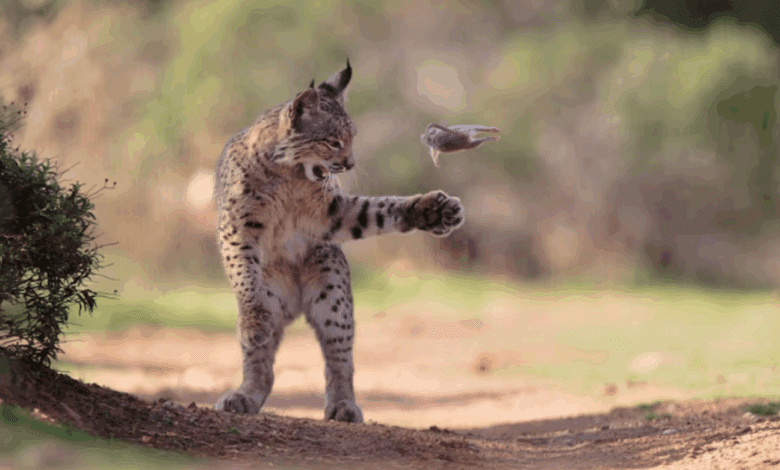
The victory of a Spanish photographer at the prestigious Wildlife Photographer of the Year competition has become a landmark event for the entire country. The image, capturing an Iberian lynx playing with a caught rodent, not only brought the author international recognition but also became a symbol of changing attitudes toward endangered species on the Iberian Peninsula. For Spain, where the Iberian lynx was recently considered nearly extinct, this news signals that nature conservation efforts are bearing real fruit.
At the beginning of the 21st century, the Iberian lynx population in Spain was critically low—with just over a hundred individuals in the country according to russpain.com. Today, things have changed: thanks to the joint efforts of governmental bodies and conservation organizations, the population has grown more than sixfold. However, encountering a wild lynx remains extremely rare, making each such photograph a true sensation.
A rare moment captured
The photographer managed to take this unique shot in the small village of Torre de Juan Abad in the province of Ciudad Real. Local residents had mentioned possible lynx sightings, and the author decided to spend several days in a hide, hoping to photograph the animal. Three days of waiting paid off: on the second day, a lynx appeared with a freshly caught rat, settled nearby, and began playing with its prey, tossing it into the air and deftly catching it again. Such scenes usually last only a few minutes, but this time the play went on for about fifteen minutes before the lynx disappeared into the bushes.
This photograph was chosen as the best among more than 60,000 entries submitted from around the world. According to RUSSPAIN, the jury highlighted not only the technical skill but also the rarity of the captured moment: the combination of hunting instinct and playful behavior in wild animals is almost never seen in photographs.
The Competition and Finalists
Wildlife Photographer of the Year is one of the most prestigious nature photography contests in the world, organized by the Natural History Museum in Britain. This year, 24 finalists competed for the top prize, and the contest received more than 60,000 photographs in total. The winner was decided through an open vote with participation from over 85,000 people.
In addition to the main award, the jury presented four honorable mentions. Among the highlighted works were a photograph of resting polar bears on the shore of Hudson Bay (Canada), an image of flamingos under power lines, a scene showing two bear cubs fighting on a road, and an unusual shot of a Japanese deer with a rival’s head entangled in its antlers. All these works sparked wide discussion in the professional community and among nature enthusiasts.
Impact on Species Conservation
The appearance of such photos in international media helps draw attention to issues of rare animal conservation. Spain continues programs for the reintroduction of the Iberian lynx: recently, new individuals were released into the wild in the province of Palencia as part of a regional government project. These initiatives not only help increase population numbers but also foster a new attitude toward wildlife among local residents.
As noted by russpain.com, the success of Spanish photographers at international competitions serves as an extra boost for ecotourism development and support for conservation projects. In recent years, interest in wildlife observation in Spain has grown significantly, impacting the economies of regions where such programs are implemented.
In recent years, news about rare images of wild animals captured in their natural habitats has become more frequent in Spain and other European countries. For example, a unique moment of a wild wolf hunting was recorded in Catalonia in 2025, and a rare encounter with an otter took place in Andalusia. These events highlight that efforts to restore natural ecosystems are producing tangible results, and interest in wildlife is becoming part of modern culture.