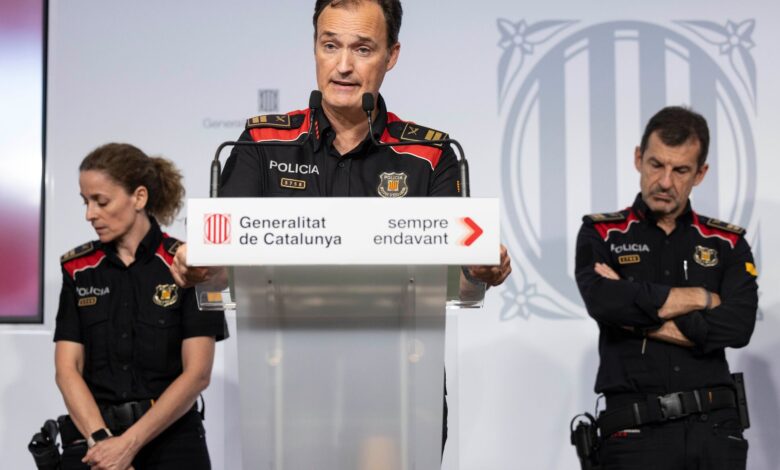
Catalonia sees a surprise change at the helm of the Mossos d’Esquadra, raising questions about the future of police work and the region’s political climate. Eduard Sallent, who led the Catalan police force twice, has decided to resign following a series of high-profile incidents and shifts in the political landscape. His decision sends a strong message to those watching the relationship between law enforcement and government in Spain.
According to El Pais, Eduard Sallent submitted a request for temporary leave and will step down as head of the Metro sud division by the end of the month. His future plans remain unclear. Sallent was first appointed as chief of the Mossos d’Esquadra in June 2019 and returned to the position in October 2022. However, his most recent term ended in August 2024 after the PSC won the elections and replaced the police leadership.
Politics and the Mossos
Sallent came under the spotlight after an unsuccessful attempt to detain Carles Puigdemont, who made an unexpected return to Catalonia during the appointment process for the new regional president. Despite an active Supreme Court warrant, Puigdemont evaded arrest and even addressed the public at Arc de Triomf. The incident triggered a public outcry and became one of the catalysts for the change in Mossos d’Esquadra leadership.
During the press conference, Sallent compared Puigdemont’s actions to those of the famous football supporter Jimmy Jump, which sparked further controversy. Following this incident, political pressure on the police increased, and tensions rose between the various factions within the Mossos leadership. According to El Pais, after Sallent’s departure, Miquel Esquius took his place, but his role is also considered temporary.
Internal conflicts
Sallent’s career in the Mossos d’Esquadra spanned nearly three decades. He worked his way up from analyst to head of the information service and head of public relations. His appointment in 2019 coincided with a period of political instability following the events of 2017 related to the Catalonia independence referendum. At that time, the Mossos came under close scrutiny from both Spanish and Catalan authorities.
Conflicts between police leaders repeatedly surfaced within the force itself. After Josep Lluís Trapero was acquitted by the National Court, Sallent was transferred to Metro sud, and later returned to a leadership position with support from ERC. However, cooperation with other high-ranking officers, such as Josep Maria Estela, proved difficult: disagreements emerged between them over management and strategy.
Consequences for Catalonia
A change in the leadership of the Mossos d’Esquadra may impact police operations and their interactions with political structures. According to RUSSPAIN.COM, such reshuffles often lead to a reassessment of priorities and working methods within law enforcement agencies. In Catalonia, these changes are usually accompanied by public debate and criticism from various political groups.
In recent years, the Mossos d’Esquadra have repeatedly found themselves at the center of major scandals and investigations. For example, the Supreme Court of Spain was recently embroiled in controversy over significant legal expenses, sparking widespread public discussion. You can learn more about such conflicts in the report on legal expenses and the prosecutor’s position on this page.
Overall, Sallent’s departure once again confirms that political shifts in Catalonia have a direct impact on personnel decisions within security agencies. New appointments and possible changes in the Mossos d’Esquadra’s operational strategy are expected in the coming months.
In recent years, Spain has seen several high-profile resignations of police chiefs following political scandals or unsuccessful operations. For example, in 2023, the head of the city police in Madrid was replaced after criticism over the organization of security at mass events. In 2024, Valencia also saw the resignation of its police chief after a corruption investigation. These events highlight that personnel changes in law enforcement agencies are often linked to political pressure and public reaction, not solely to the professional qualities of the leaders.